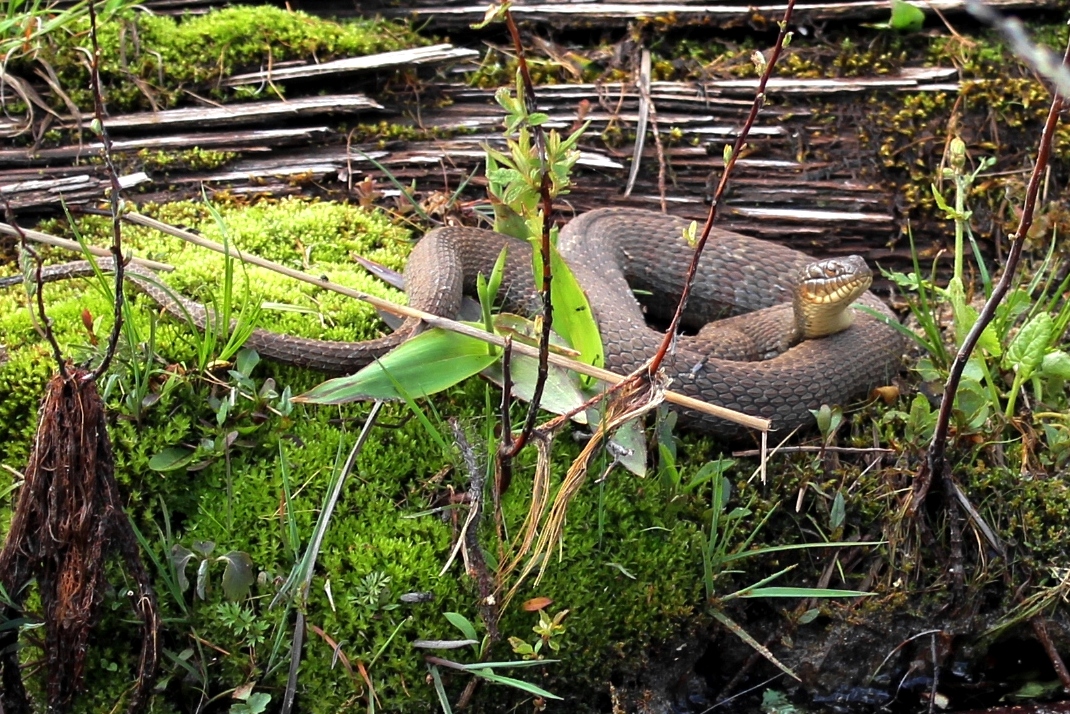
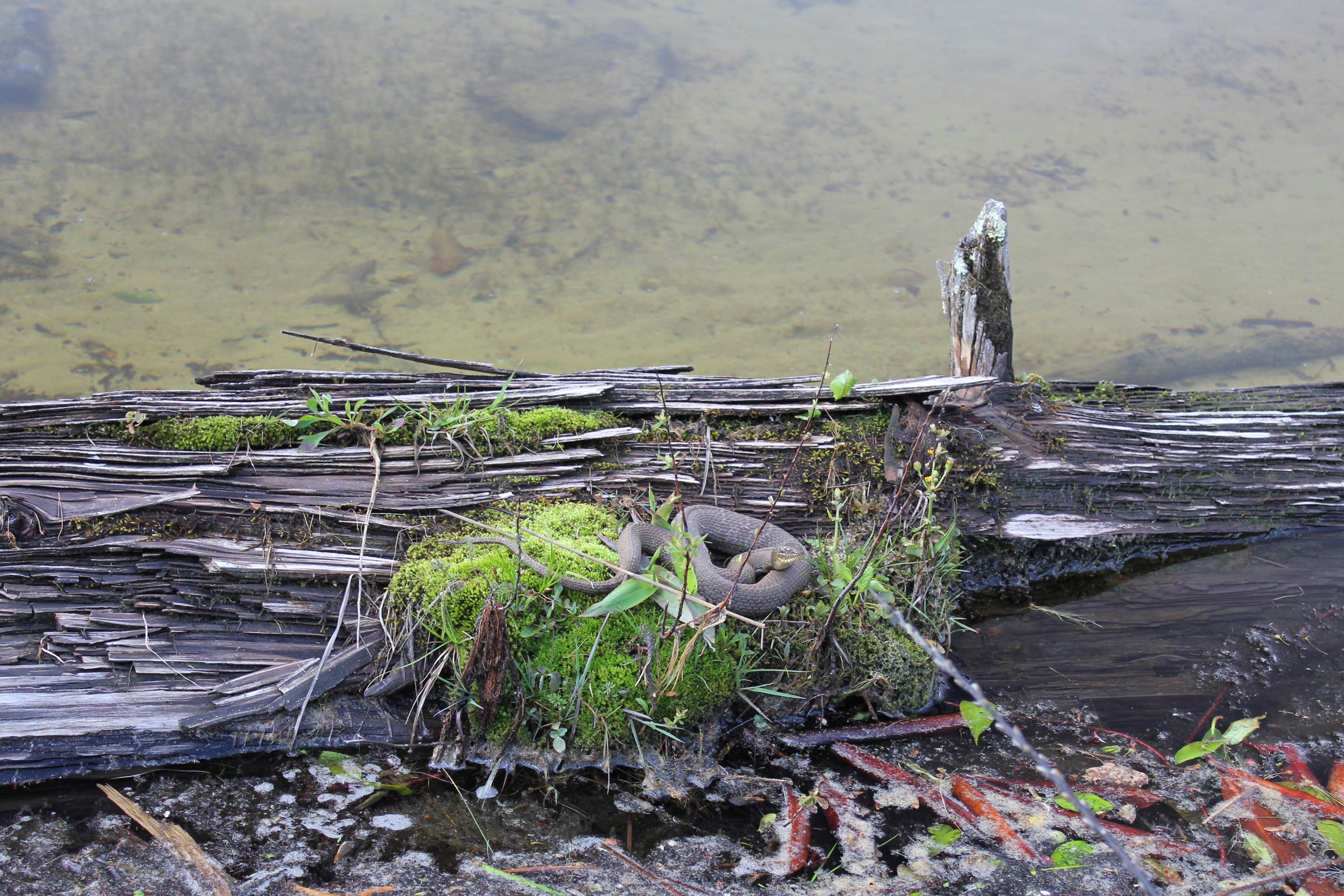
This is a water snake I photographed at Hidden Valley lake a few weeks ago.
Water Snake – Close Up
This photo was taken near the dam on the eastern side of the lake. The snake was almost three feet in length, which based upon the research is fairly good sized for this kind of snake. Water snakes, or Northern Water Snakes as they are sometimes known, are not poisonous but can be aggressive and have a painful bite. They feed on frogs, fish, and other water-based prey. These snakes are found throughout Virginia according to the VDGIF map of occurance for this species.
Here is a photo identifying the major peaks visible from Buzzard Rocks, the outcroppings about 200 vertical feet below the summit of Whitetop Mountain. Buzzard Rocks provides one of the best vistas towards Southwest Virginia, looking back into both Virginia and Tennessee. The small communities of Whitetop and Green Cove can be seen in the foreground.
View from Buzzard Rocks – Click to Enlarge
Buzzard Rocks can be accessed via the gravel road 89 from State Route 600 near Elk Garden, via the Appalachian Trail from Elk Garden from State Route 600, or via the climb from State Route 601.
The pointy mountain labeled 3700′ is Fodderstack Mountain. This is a promentory that divides the valley towards Laurel Bloomery in Tennessee. Tennessee Laurel Creek runs down this valley between Fodderstack and the Iron Mountains towards Damascus.
Between the Iron Mountains and Holston Mountain lies Shady Valley, Tennessee. Beaverdam Creek runs down this valley from Shady Valley towards Damascus. On the other side of Holston Mountain is South Holston Lake, the TVA impoundement that is the largest lake in region.
Between Holston Mountain and Clinch Mountain (which is barely visible on the far horizon) is the great valley that encompasses most of Washington County, Virginia, including Abingdon.
For a comparison, here is another view in the evening from the same vantage point, slightly below Buzzard Rocks.
This article reviews the newest federally protected area in Southwest Virginia, the Seng Mountain National Scenic Area.
Rowland Creek Falls
In 2009 the United States enacted the Virginia Ridge and Valley Act of 2008. Sponsored by Senator John Warner (R-VA) and Rick Boucher (D-VA), the Act preserved over 50,000 acres of wilderness areas in the western part of Virginia. Part of the Act created the Seng Mountain National Scenic Area, a 6,500 acre tract, and the Bear Creek National Scenic Area, a 5,500 acre tract (I will review the Bear Creek National Scenic Area in a future article). See16 U.S.C. § 546b. The designation of these tracts as “scenic areas,” as opposed to “wilderness,” was a compromise to allow continued non-motorized recreational use by cyclists (mostly single track mountain biking).
Some groups and individuals have known about this part of the northern ramparts and mountainsides of Iron Mountain for a long time. The Seng Mountain area has been part of the Mount Rogers National Recreation Area for 25+ years. The scenic area designation simply gives it more protection and makes permanent the designation of the area as one for the limited recreational uses enumerated in the statute. Ok—enough with the legal mumbo jumbo—let’s talk about the area itself:
The area is located in the southern section of Smyth County and is about 30 miles as the crow flies from Abingdon. Its boundaries are roughly Route 600 (Skulls Gap) on the west, Hurricane Campground on the east (off of Route 16), Forest Road 84 near the top of Iron Mountain on the south, and private land near the Stony Battery community on the north.
There are two major single track trails that cross the scenic area, Jerrys Creek Trail on the west side, and Rowland Creek Trail on the east side. Each of the trails follows a small creek that runs down the mountainside. The high point in the scenic area is Round Top Mountain, 4626′.
Mountainsides Draw Close Together to Form Miniature Gorge
In mid-April my family and I drove to the upper trail head of Rowland Creek Trail. Our starting point was at 3850′. You reach this trailhead by traveling on FR 84, which is a gravel forest road. Getting to the trailhead from Route 600 takes about 20-25 minutes.
This is an unusual mountain hike, in that the hike starts the top, so you start hiking downhill, and return going back uphill. Rowland Creek trail starts out wide as it descends around Seng Mountain, down towards the headwaters of the creek below. The area forms a mini-gorge, as the mountainsides are steep and drop quickly down into Rowland Creek.
Rowland Creek Trail - Steep Switchbacks
Where we started, on FR 84, there were no leaves. However, within a half mile of going down the trail, we descended into the foliage of springtime. The protection of the gorge-like formation protects the trees below from the elements, creating a micro-climate that is much milder than at the top.
Leafed Out Trees Below Contrast with 4000'+ Bare Ridge Lines
After several switchbacks, you arrive at the headwaters of Rowland Creek. There are some nice potential campsites at the upper end of the trail, within easy walking distance of the creek.
Moss Covered Rocks and Boulders Photo by Karl Thiessen
One thing we noticed is that the trail was quite moist and rutted out from horses near the creek. It is probably extremely muddy after rains. The trail roughly parallels the creek the rest of the way down the mini-gorge.
The area along the creek is lush. We spotted numerous flowers. A bit of research shows that the trilliums we saw are native to the Southeastern United States, particularly in mountainous, gorge-like hollows such as that on this trail. They bloom in April or May at the earliest, while sunlight reaches the forest floor before the trees are fully leafed out.
Southern Red Trillium Photo by Karl Thiessen
One thing we were not anticipating, but had some fun with, were the creek crossings.
Rowland Creek Crossing Number 1
While none of the creek crossings were too difficult, we were hiking after several dry days. The trail could likely become completely washed out, and the creek crossings more difficult (at least to get across without getting soaked) under wetter conditions.
Rowland Creek Crossing 2
Even our dog, Magnus, was enjoying the creek crossings (here is creek crossing 3):
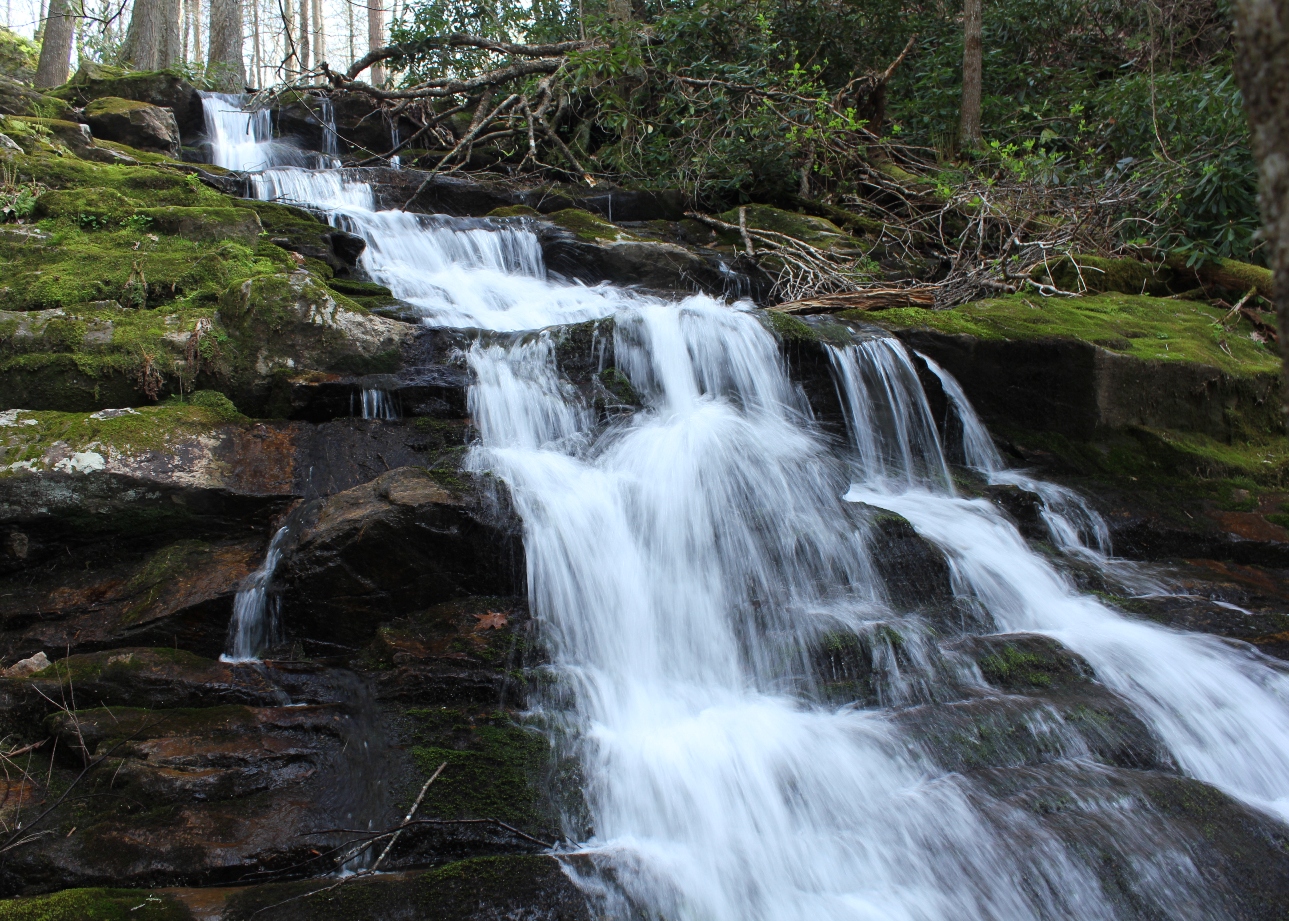
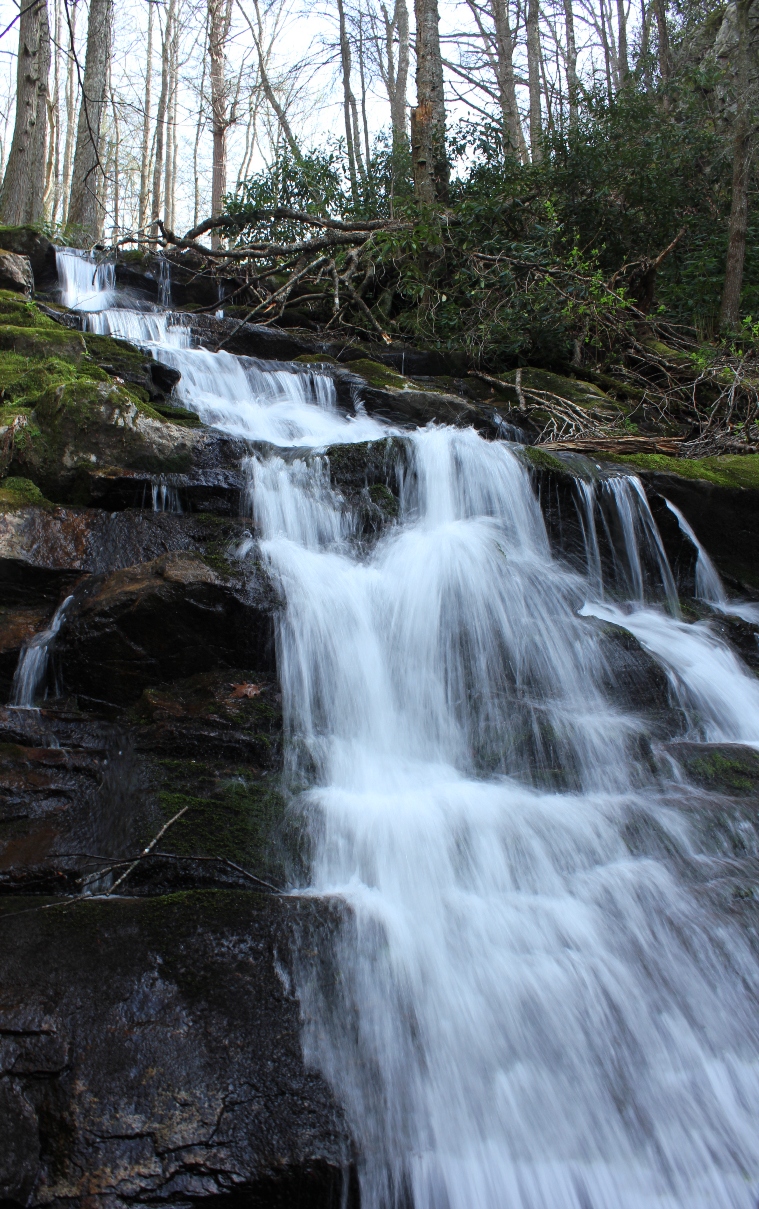
The highlight of this trip is most definitely Rowland Creek Falls, a 50′ cascade-type waterfall that drops down a series of stairs for about 80-100′.
Upper Rowland Creek Falls
The falls are not directly on the trail, so we needed to go down a hill in order to get some clean shots of the cascades.
Multiple Cascades
My son Karl made it all the way to the bottom and took some nice shots of the lower end of the falls, including this photo:
Lower Rowland Creek Falls Photo by Karl Thiessen
Below is a map of the entire scenic area. Rowland Creek Trail and Jerrys Creek Trail can be connected by either FR 84, or an older, no longer used forest road that parallels FR 84 about 100′ downslope of it. This loop is about 12 miles in length. It is also used by mountain bikers, although there are sections that are very difficult due to the grade and the wetness near the creek beds.
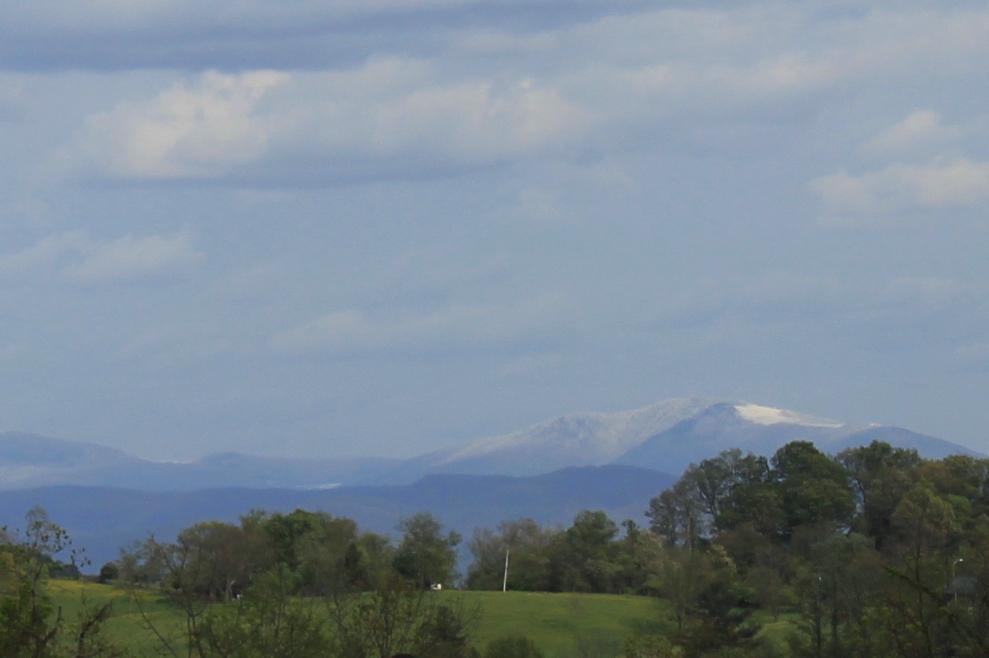
The section of the Blue Ridge Parkway that skirts around Grandfather Mountain is most impressive. This is the site of the famous Linn Cove Viaduct, where the Parkway is raised up on pylon-like stilts and skirts around part of the mountain as if suspended in midair. This whole section of road has impressive views of the mountain, and off to the east and southeast, all the way to the Piedmont region.
The photo above was taken in March near mile marker 302—right before you begin rounding Grandfather Mountain when approaching from the Blowing Rock Area. Low hanging cumulus clouds accentuate the blueish hue of the mountains. The photo views the mountains and hills to the southeast (Grandfather Mountain is not in the picture but is to the right from this viewpoint, on the other side of the Parkway from this turnoff).
This March we visited Linville Falls, one of the most famous waterfalls in North Carolina, during the 2012 Banff Film Festival in Boone (the inspirational film festival trailer can be seen here). The falls are located just off the Blue Ridge Parkway at mile marker 316. There is a visitor’s center and a short hiking trail (about .8 miles) to the falls.
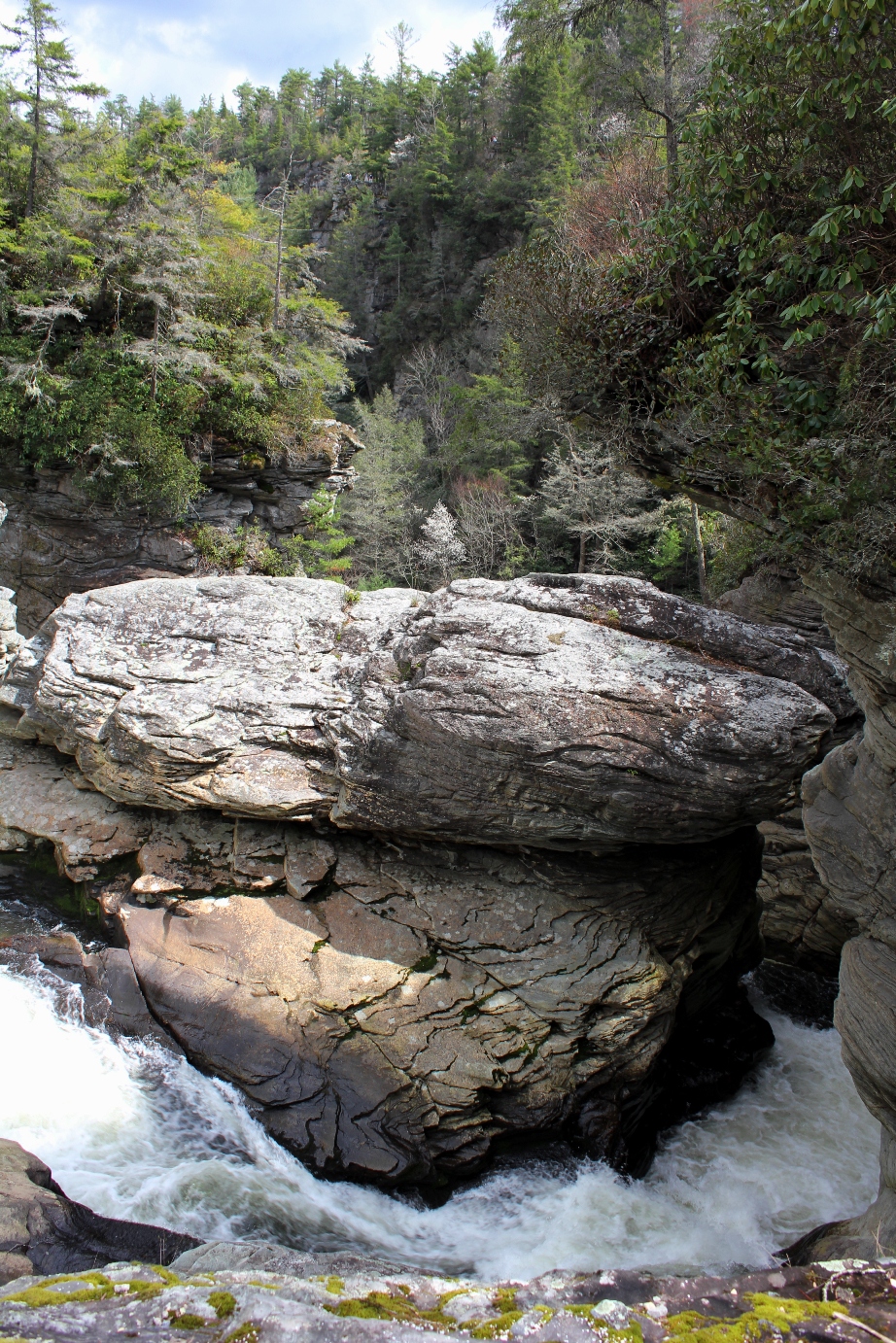
Water Swirls Around Ancient Stone
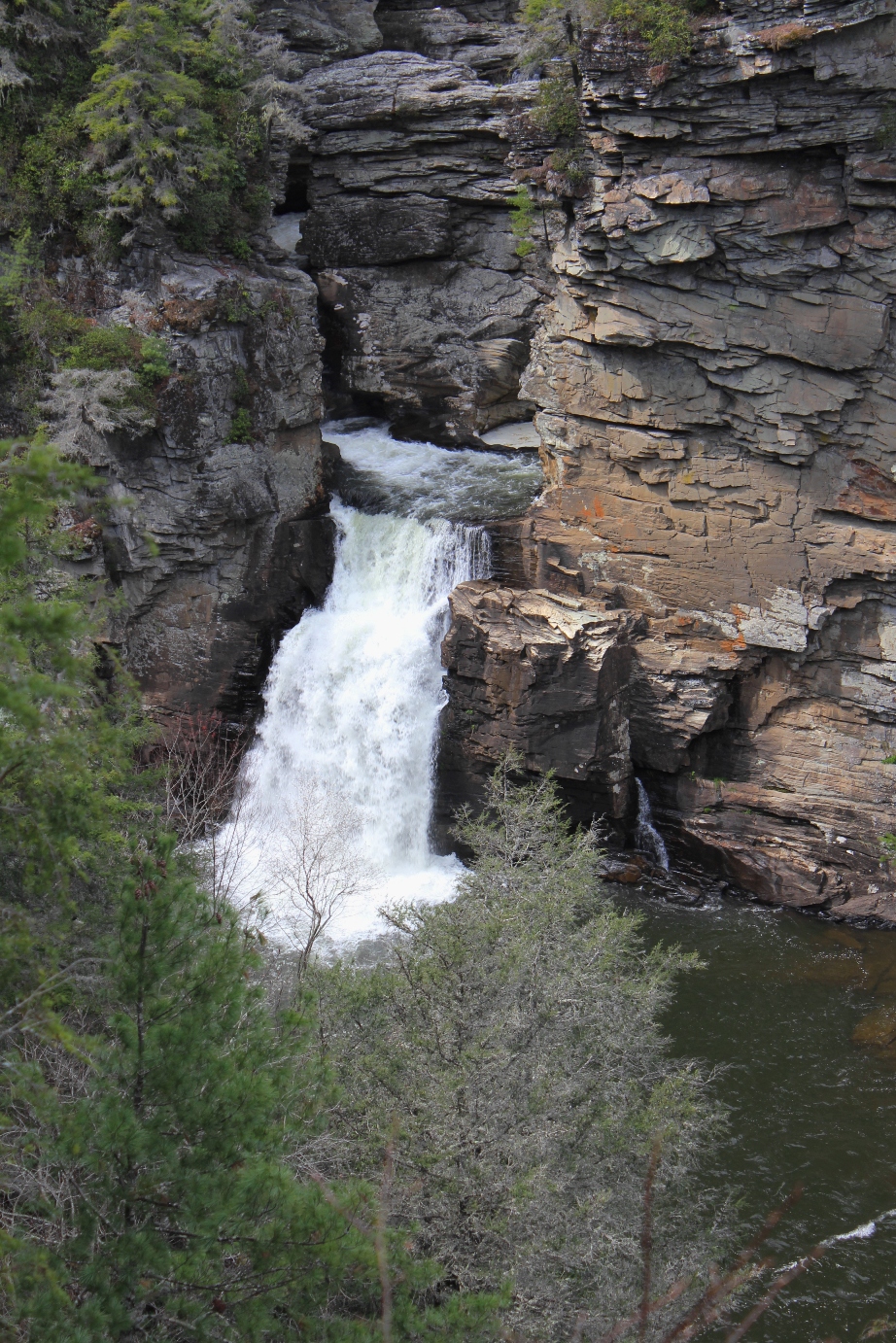
The closest viewing area shows the upper falls (not pictured here) in one direction, and beginning part of the lower falls in the other direction. The photos above and below show the beginning part of the lower falls. The lower falls churn through a cavernous semi-circle of eroded limestone, and then plummet about 45 feet into a large pool.
Water Diverted in a Semi-Circle Above Linville Falls
“Chimney Rock Overlook” can be seen from the upper viewing area, as highlighted in the photo to the right. From Chimney Rock Overlook, you can see the lower falls in their entirety, as well as the large cliffs that surround the falls and mark the beginning of the Linville Gorge.
Highlighting the Overlooks Shows the Scale of these Falls
The cliff face next to the lower falls is as impressive as the falls themselves. When we viewed the falls, there was a relatively large volume of water flowing. This caused the falls to jettison outward from the upper pool.
Linville Falls is a very popular stop on the Blue Ridge Parkway (the parking lot at the visitor center is huge), so it is recommended that if you want to visit the falls without hordes of tourists, you should try to see them during less visited times of year such as in spring or winter, or during the middle of the week.
The viewing areas were built in a manner to try to fit into the natural surroundings and are constructed of stone and logs. When they are wet, it is possible they could be treacherous. In particular, the Chimney Rock overlook could be dangerous if someone got too close to the edge of the viewing area, as a fall from that location could be fatal.
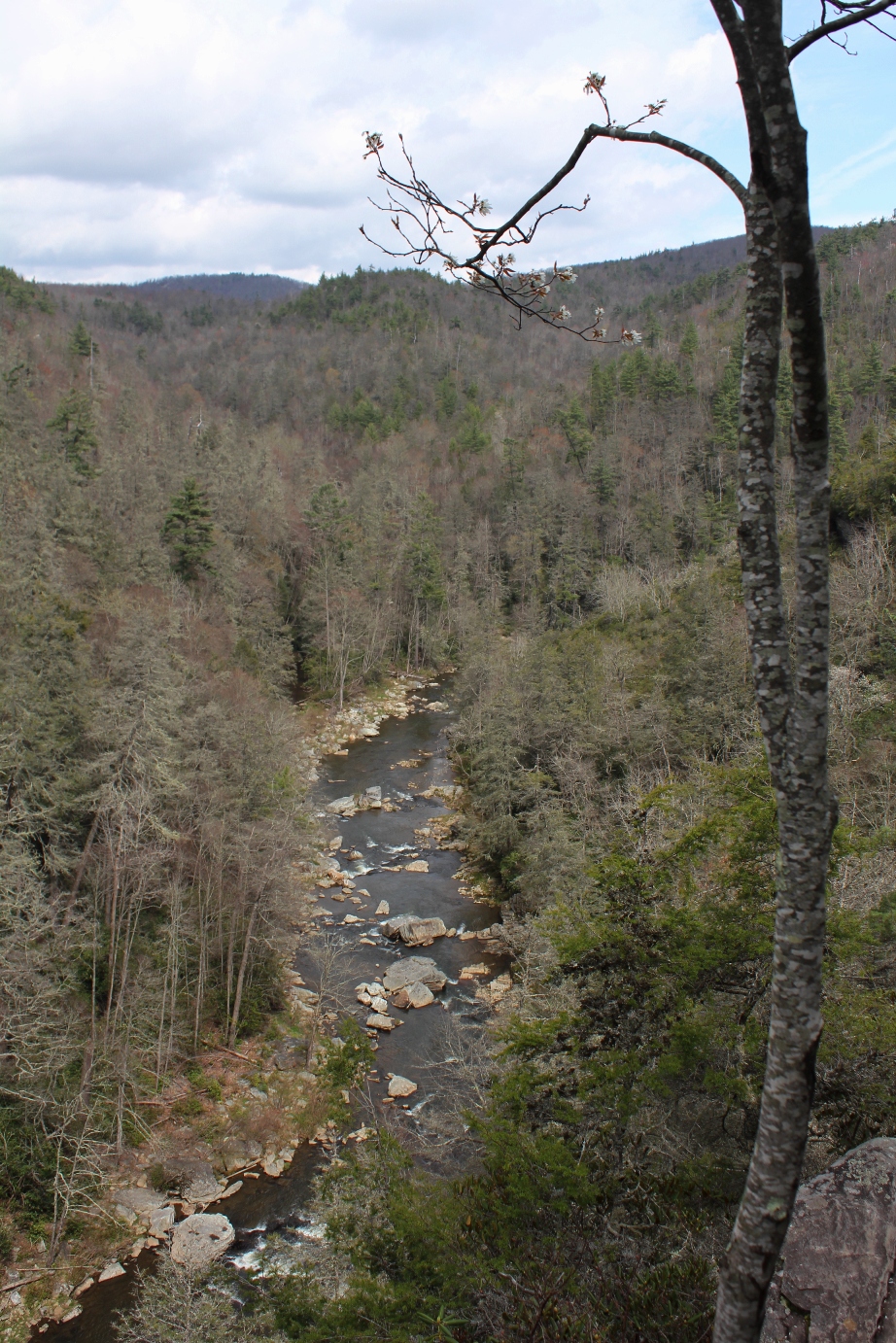
The Linville Gorge is one of the deepest gorges in the Eastern United States. I have seen claims that it is in fact the deepest, but there are several others that are comparable (including the Russell Fork Gorge in Southwest Virginia). Suffice it to say that it is deep and impressive. Experienced hikers have become disoriented and lost in this place.
Linville Falls from Chimney Overlook
The Linville Gorge reminded me of the gorge below Abrams Falls close to Abingdon, although without doubt the Linville Gorge is much deeper and longer.
If you find yourself in Boone, Blowing Rock, or on the Blue Ridge Parkway in this neighborhood, a trip to Linville Falls makes for a nice day trip and provides a nice little outdoor experience without too much effort.
Most folks who visit Blowing Rock, North Carolina are on vacation from far away, usually in summer to escape the oppressive heat in places like Florida or maybe Charlotte or Atlanta. Not so for Abingdonians—for us, it’s just hop, skip, and jump over the mountains. It’s exactly 60 miles from Abingdon to Blowing Rock. Perfect for a day trip.
Well Maintained Carriage Paths Encircle Bass Lake, March 2011.
About a mile outside of Blowing Rock, just off Route 220, is the entry to Bass Lake, part of Moses H. Cone Memorial Park. An easy day trip from Abingdon (although certainly meriting a long longer trip if desired), the Moses H. Cone Park is a large, outdoor park managed by the U.S. National Park Service.
Moses H. Cone Mansion, circa 2007
We have been visiting this park for years. One of our spring rituals, when it’s warming up and we are getting cabin fever, is to come over here on a March weekend, before the crowds swarm Blowing Rock.
The walk around Bass Lake, about a mile, is the perfect family walk. There are a multitude of trails lacing the park that go far beyond the lake. A map of the trails, somewhat dated, from the National Park Service is located here.
Mrs. Abingdon Outdoors Revealed: Joanne and Isaac on the porch rail of the Cone mansion, circa 2007. Note the view of the lake in the background.
This is a great place to come to relax—lunch at one of the many restaurants in Blowing Rock and a stroll around the grounds of the estate makes for a nice day.
Aqueduct leading to Bass Lake. Note the mansion at the top of the photo.
Moses H. Cone was a textile magnate that built his country estate in the very early 1900s similar to Vanderbilt’s estate in Asheville. The Cone estate is not quite as exorbitant as The Biltmore, but with 3,500 acres of land and a 13,000 square foot mansion that overlooks the mountains, it’s undeniably grand. The estate was designed with the mansion, which sits at about 4,500′, overlooking the man-made lake and the carriage trails that meander down towards Blowing Rock. More information on the background to the creation of the estate is located here.
The house is open to the public, and is accessed off of mile 295-298 of the Blue Ridge Parkway. While the mansion is worth a visit, what keeps us coming back are the grounds. Imagine Virginia Creeper Trail type trails: well-maintained cinder or pea gravel covered trails.
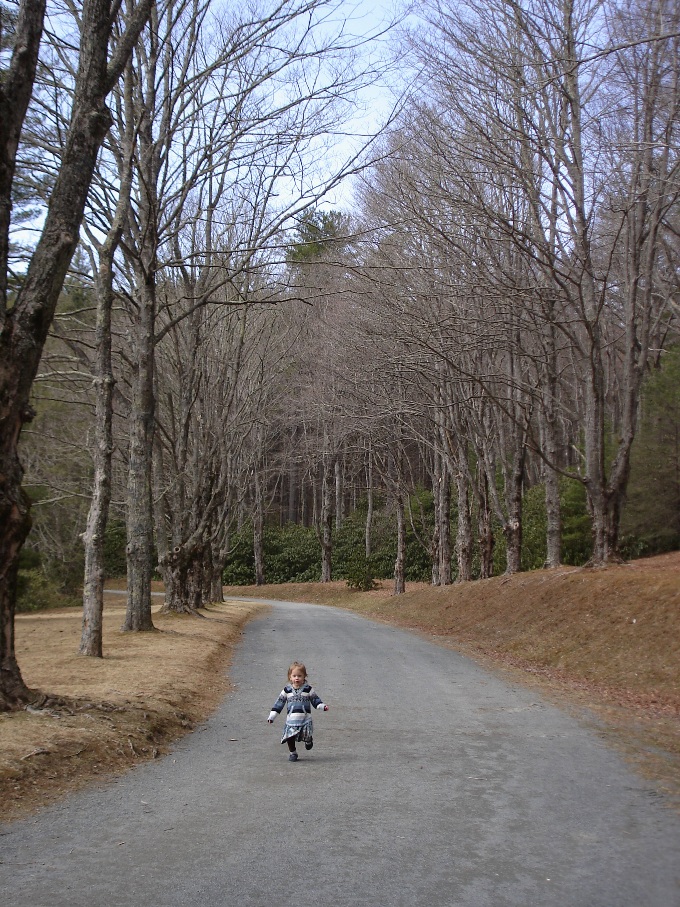
Future Runner Practicing on the Carriage Path, March 20, 2011
The trails crisscrossing the ground make for an excellent area to train for running. In fact, most times you are here you will see some locals, part-time residents, or visitors running on the carriage trails. Next time you are in the Boone-Blowing Rock area, check out this park. You won’t be disappointed.
Whether it was due to family travels in my early years, the Rand McNally World Atlas my brother gave me for my ninth birthday (back in the days when the world was not a mouse click away), or the historical maps we used in high school and college, I’ve always enjoyed peering over and studying maps.
There is still something to be said for a paper map, even a plain old USGS quadrangle. As an outdoorsman, my favorite maps currently are the hard copy National Geographic Adventure/Trails Illustrated maps. The tactile experience of taking a paper map into the outdoors and comparing notations and contour lines to landmarks and the land itself with the assistance of only a compass and the naked eye is still the essence of orienteering. It’s hard to imagine Lewis and Clark, Daniel Boone or Jim Bridger using a hand-held GPS. The accomplishment and romance of their legendary explorations into the vast unknown American frontier would just not be the same thing if they had had the assistance–the crutch, if you will–of modern mapping and satellite technology.
Not that GPS or other electronic maps aren’t awesome in their own ways. Which brings me to the maps in this essay. Several months ago I came across an article in the London Telegraph that contained a link to these Twitter and Flickr maps. Eric Fischer created these unique maps from Twitter and Flickr metadata. Twitter is of course the ubiquitous microblogging website, and Flickr is the premier photo sharing application/website in the world.
Mr. Fischer was able to collect where people geotagged their tweets and uploaded Flickr photos over a period of time in 2011. The tweets are in blue and the Flickr photos are red (overlapping areas appear white). Presuming his sample size was large enough, the maps are probably accurate today. They certainly would appear to correlate with my own idea of where people would be more likely to take geotagged photographs.
The white areas are the most populous areas, and probably where there is more economic activity. So if you are interested in living in areas of high levels of microblogging (and most likely, more economic activity), the white areas on the maps would be the place for you.
If, on the other hand, you are more interested in the most photographed areas where there is less human activity, the red areas would be of interest. In the map below, I have noted some of the significant national parks, recreation areas, and wilderness areas in the United States. These areas correlate closely with high levels of Flickr geotagged activity.
For example, the Rockies generally but Glacier, Yellowstone and the Grand Canyon national parks specifically are among the “hottest” geotagged areas of the country. Other out-of-the-way places, like the Boundary Waters Canoe Area, also stand out. (You really have to click on this photo to see the enlargement and appreciate the Flickr data.)
The Most Photographed and Geotagged Natural Landscapes - Click to Enlarge
A closer look at Abingdon Outdoors country shows how our region is practically an island of red along the East Coast. The red spine of the Blue Ridge is clearly visible in the enlargement below, and in the Southeast, the mountainous area of Southwest Virginia, Western North Carolina, and Great Smoky Mountain National Park are the most photographed areas south of New England.
Our region is also unusual in that we are a “red zone” surrounded by white–a relatively less populated, highly photographed area surrounded on all sides by the major population centers of the Mid-Atlantic and Southeast (Washington, Richmond, Charlotte, Atlanta).
Human activity can be very telling about where it is beautiful. In these maps, the red shows what are likely the most photographed, less populated areas of our country. On the United States map above, our region looks similar to the Cascades area of Washington and Oregon, and the Sierra Nevada region to the east of San Francisco.
Lots of people apparently agree that Abingdon Outdoors country is pretty country indeed.
Abingdon Outdoors Country: The Blue Ridge and Southern Appalachians
Check out these photographs of falcons and falconry from a new Northern Virginian blog on photography. Falconry, the ancient sport of taking quarry with raptors, is not widely practiced in the United States, although there is a Virginia Falconers Association.
A Falcon's View in Tennessee
If you investigate a little bit you will learn there is normally an “apprenticeship” whereby an aspiring falconer will work with a more senior bird handler to learn how to trap, manage and train a falcon. The apprenticeship may take years. Falconers must obtain U.S. Fish and Wildlife Permits in order to trap and keep these birds.
Having a falcon return to you and land on your arm would be exhilarating—presuming, of course, that you were wearing a protective gauntlet (otherwise your exhilaration would be tempered by extreme pain as the raptor’s talons clamped down on your forearm).
These photos reminded me of a backpacking trip a friend and I took several years ago wherein we accidentally came upon several wild raptors that flew extremely close to us. It was a bit unnerving to have birds of prey buzz so closely by. A few minutes later we would realize why the birds were flying so close to us.
We were hiking the Appalachian Trail in the Bald Mountains, up on the North Carolina-Tennessee border about 10 miles north of Sams Gap. As we rounded some large boulders, we accidentally came upon the Big Bald Banding Station. There were some individuals near the summit of Big Bald Mountain collecting data, and there were birds of prey that were either nesting or returning to the area. There were also some large bird cages, and, if I recall correctly, we observed several birds being released.
The sheer randomness of our coming upon these guys and watching the magnificent birds was pretty neat. In fact, we were so surprised that neither of us remembered to take our cameras and photograph the birds. We probably could have gotten some shots like those in the article highlighted above. The birds we saw were not trained, but were wild and free and were probably just passing through, stopping briefly on their way south for the winter.
On Top of the World - Eastern Falcon Migration Throughway
Big Bald Mountain, at 5516′, is one the higher points on the AT (and the highest between the Roan balds to the north and the Smokies to the south). The hike on the AT from Spivey Gap (Route 19W, aka Spivey Mountain Road) to Big Bald Mountain is a steep, rugged hike. The Bald Mountains are a natural bird migration throughway, and both large birds and smaller species cross the mountain during the seasons.
Southern Exposure: View of the Smokies from Big Bald Mountain
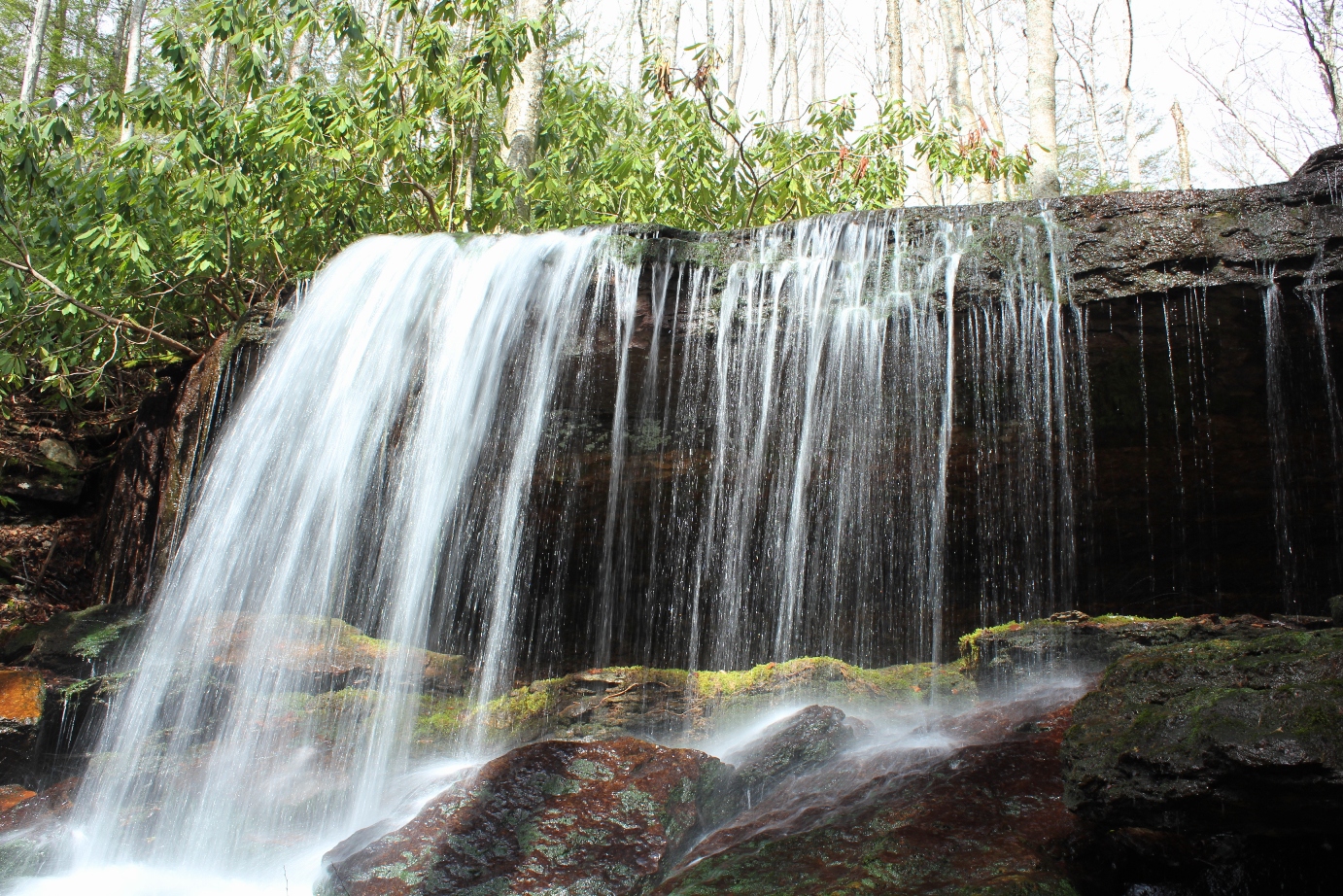
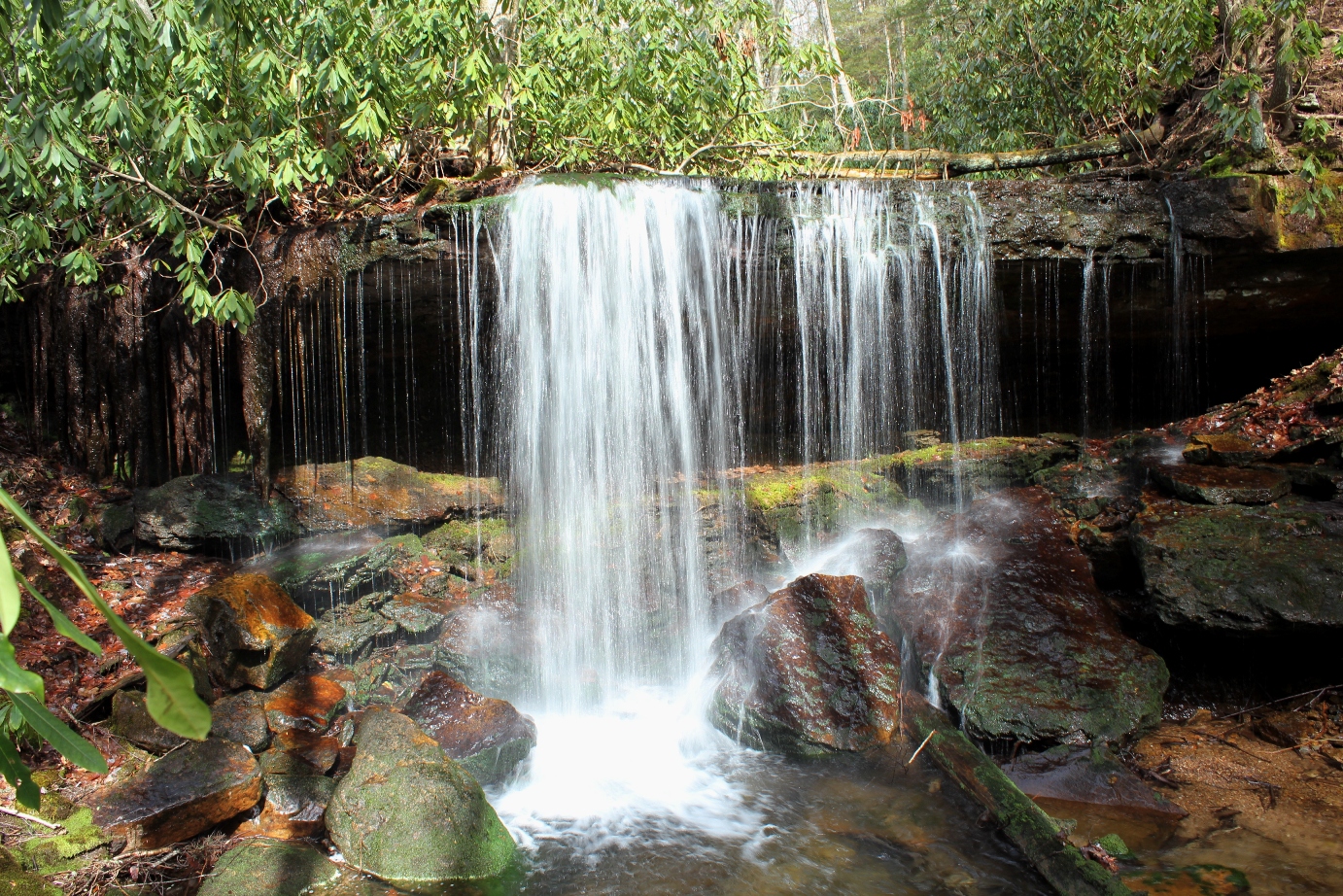
Immediately above the confluence of Little Brumley Creek and Brumley Creek on Clinch Mountain is a unique 16-20 foot plunge-type waterfall known as Little Brumley Creek Falls.
Little Brumley Creek Falls
This past weekend some friends, my son, and I hiked, climbed across mountainsides, and otherwise bushwhacked through state forest to reach this remote waterfall.
This waterfall is unique in that the waterfall drops over a huge slab of overhanging rock. There is a shallow cave behind the falls. You can actually get up in the cave and walk behind the falls.
Little Brumley Creek Falls Front View
Here is some footage of my son and another person in our party walking behind the falls:















 Abingdon Outdoors
