In 1934, the Civilian Conservation Corps began construction on the trails of Hungry Mother State Park in Marion, Virginia. In 2012, the trails still provide hikers, runners and mountain bikers great recreation opportunities.
The Promentory on Top of Molly's Knob
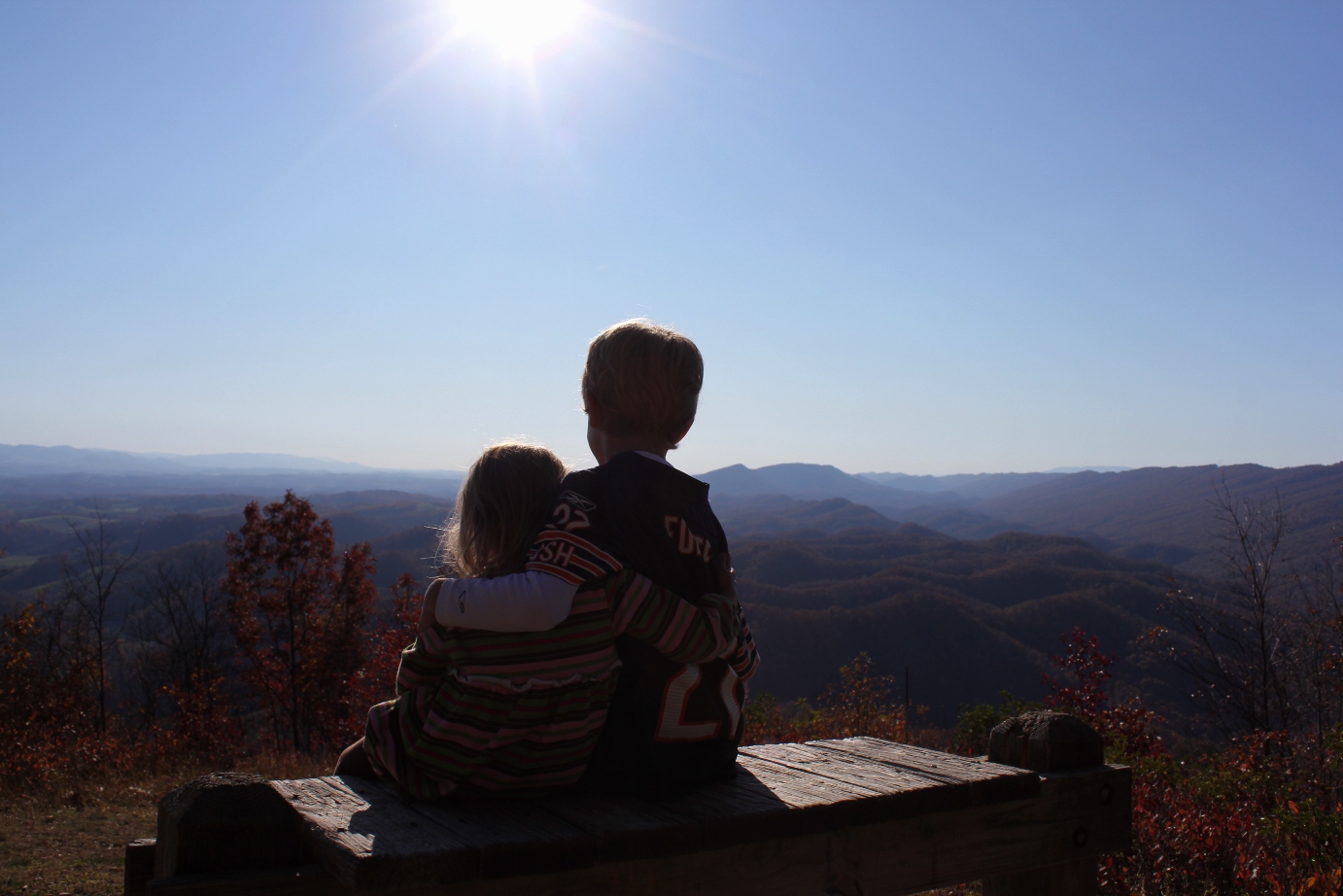
In late October 2011, my son Isaac and I (with my daughter Josephine in a backpack carrier) hiked up to Molly’s Knob, the highest point in the park. This is a classic day hike in Southwest Virginia. Molly’s Knob is a sharply rising promentory knob that is about 3500′, rising slightly over 1000′ from the lake. The hike from the lake is about three miles, making for a six mile round trip.
Hungry Mother Lakeshore
Over the years, Hungry Mother State Park has been a major training ground for me, particularly for running, mountain biking, and kayaking. The trails are not your typical Southern Appalachian foot trails—we’re not talking root-laden, AT-type trails.
As you would expect for trails constructed by the CCC, these are similar to the U.S. National Park trails across the country. The trails are wide enough in most places for two people to walk abreast together, especially the main trail around the lake (appropriately named the Lake Trail). (If you add about a hundred yards to a run around the lake, you have almost exactly 10k.)
Other than the Lake Trail, the trails weave up and down the mountainside, mostly on the backside of the lake. The map of all the trails is located on the state park website, here.
There is good signage throughout the park; all trails are marked.
The first time I ascended to the top of Molly’s Knob, sometime in the mid-1990s, it was on a mountain bike, and I was huffing and puffing attempting to follow my brother-in-law up the trails. While I still see mountain bikers on these trails, the climb to Molly’s Knob is more enjoyable, in my opinion, as a regular hike.
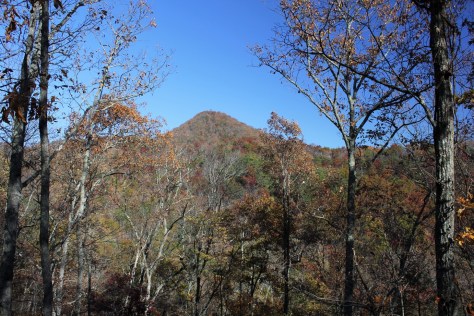
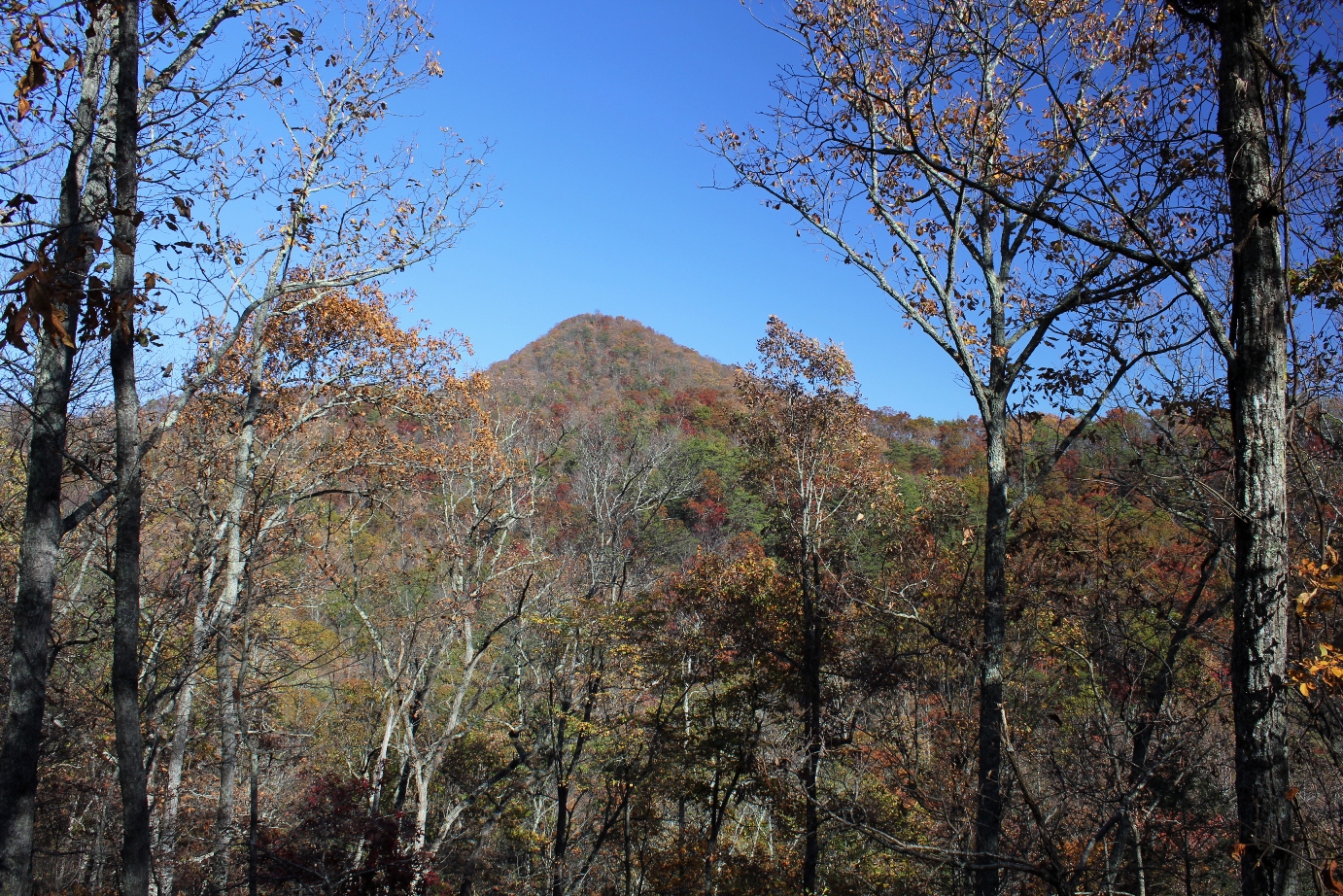
View of Molly’s Knob from the trail. The knob is about 1000′ feet above the Lakeside Trail.
Most of the trail is a steady climb along ridgelines that gradually ascends the mountain. The last half-mile of the trail is a spur that circles around to the backside of the top of the knob and is quite steep. If you are on a mountain bike, it is probably best to dismount and just hike-a-bike up to the top.
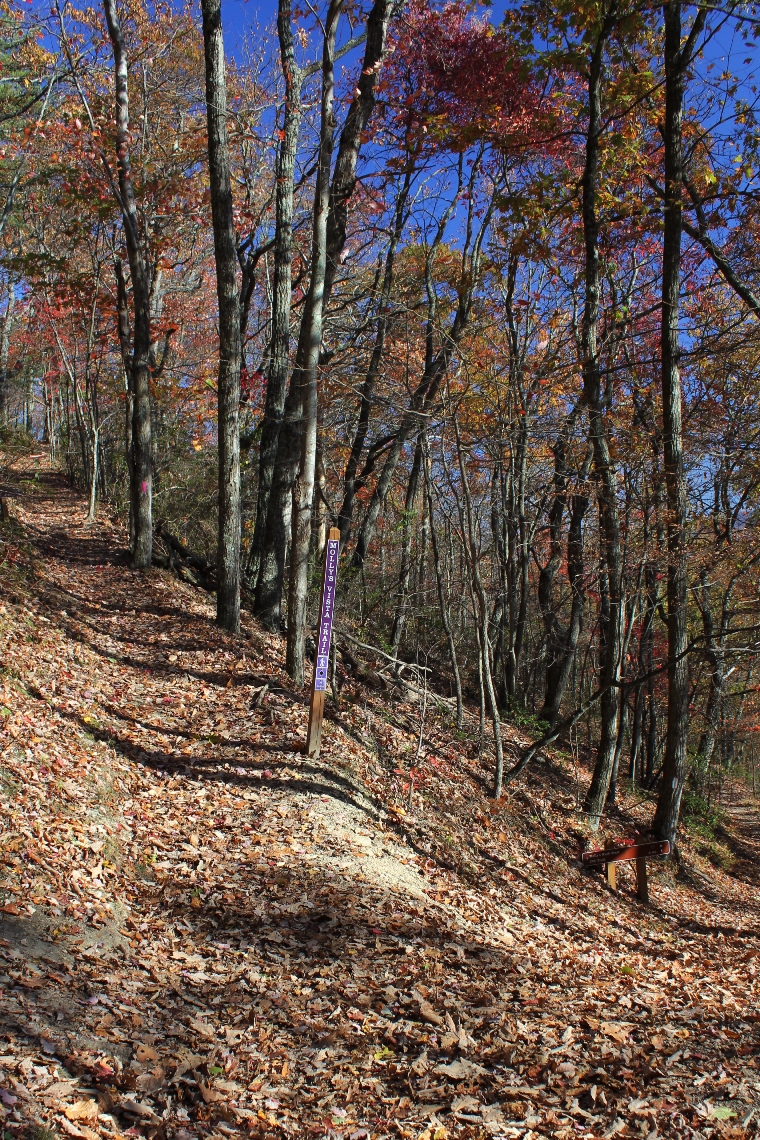
Molly Vista Trail Spur, a steep spur leading to the top. It is about .4 miles to the summit from this point.
The photos above and below show the start of the final, steep climb. It gets considerably steeper than in these photos in the final section.
Close up of the trail marker.
As you climb the mountain, the views of the surrounding mountains begin to open up. Below is one of the first views of Mount Rogers and Whitetop to the south.
View of Mt. Rogers and Whitetop mountains from Molly Knob Trail.
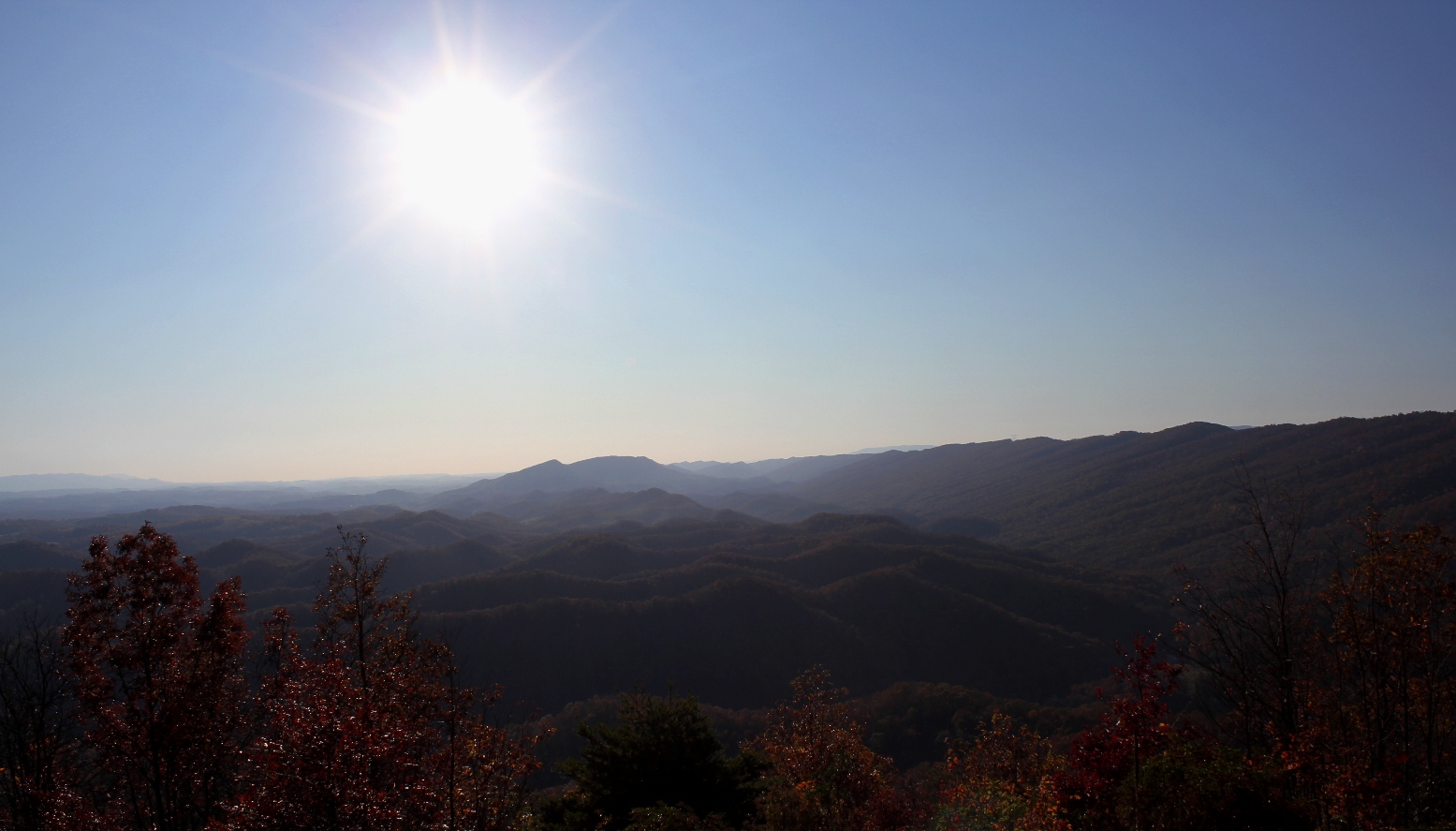
The view from the knob looks southwest, directly down the valley-and-ridges. There is, however, a prominent smaller mountain that rises adjacent to Big Walker Mountain. This is the mountain shown in the photo below.
Late Afternoon Sunburst
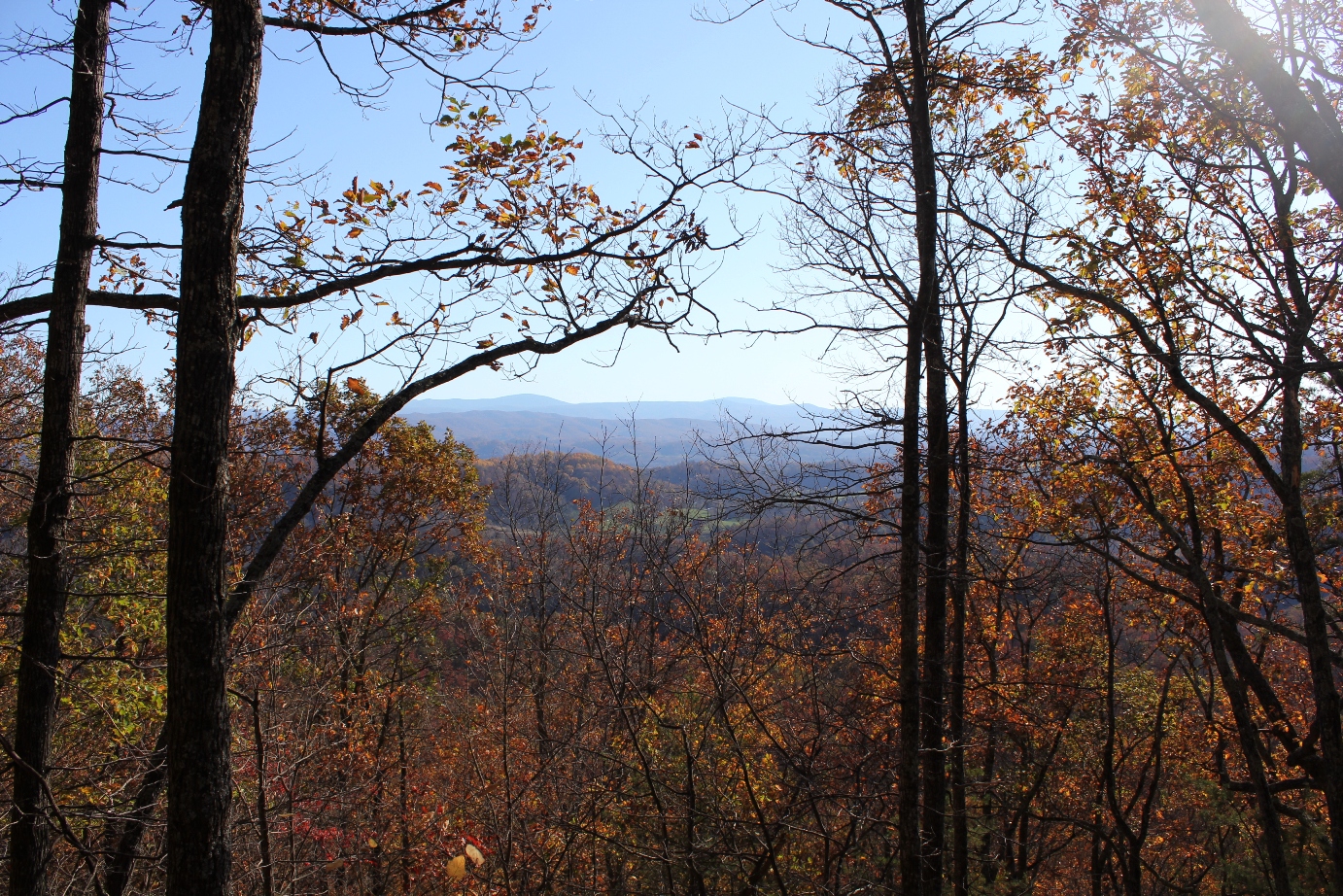
In the photo below, you can see the view of the valley below. I-81 runs down there somewhere, thankfully hidden in the folds of the hills, along with the Middle Fork of the Holston River.
Valley View
Below is another view looking south. From this point, at the top of the mountain, you make out Mount Rogers (to the left) and Whitetop (to the right), with Iron Mountain rising about 3/4 of the way up in front of those two peaks.
Mount Rogers and Whitetop mountains as viewed from Molly's Knob.
Below is another view looking out from the top of the knob. There was smoke from a fire in the photo.
View from Molly's Knob.
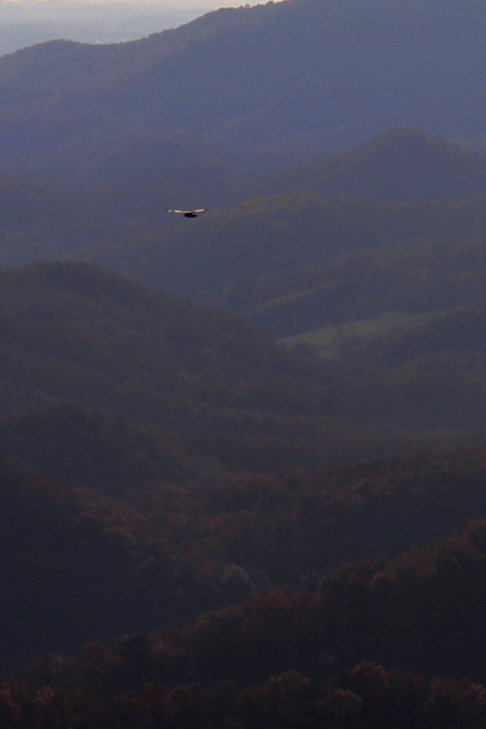
To the left of the fire, probably too small to be seen in the photo (unless you click and enlarge it), there was a hawk soaring on the thermal upwind currents. It is easily seen in the close-up photo below.
Hawk Gliding on Thermals
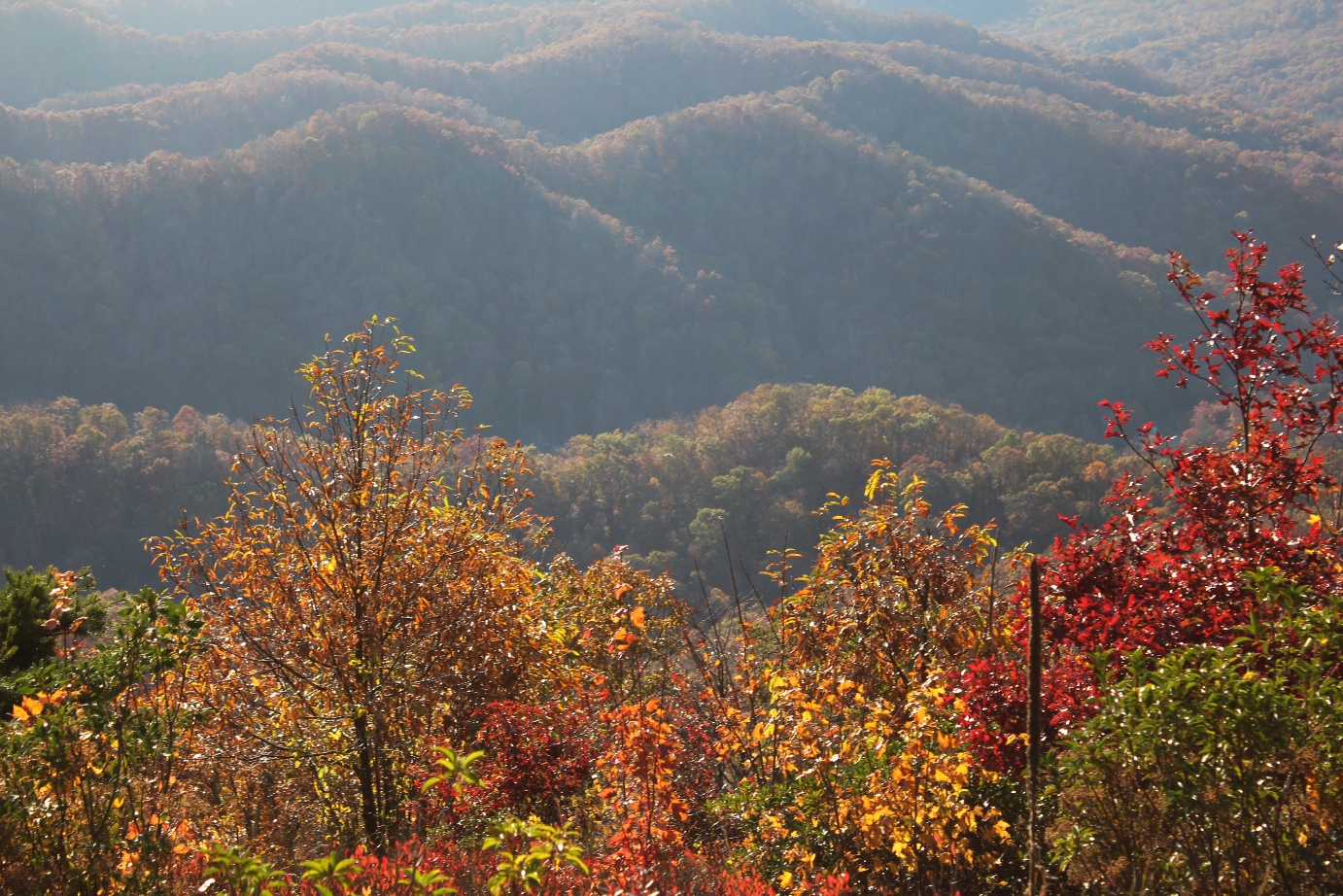
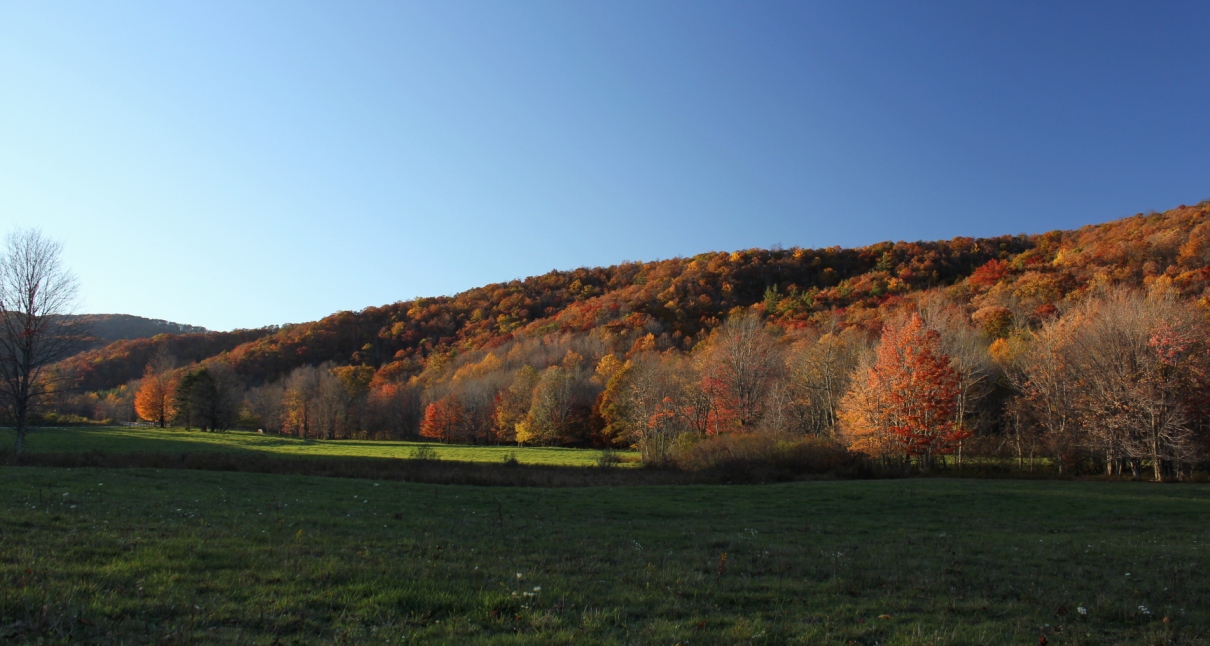
This hike was toward the end of October, and while the brightest fall colors had already peaked and passed, there was still some wonderful auburn and golden foliage on the mountainsides.
Late fall colors as viewed from the knob.
Depending upon your level of fitness, this may be considered a moderate or a strenuous hike. It’s definitely one that reasonably fit children over the age of 10 or so are capable of, especially if you pack water, some goodies, and take some breaks.
The three-mile section of the Appalachian Trail from Route 601 to the top of Whitetop Mountain rewards hikers in all seasons. In the late fall and winter, vistas open through the canopy on the mountainside, and the generally clearer skies provide better long-range views.
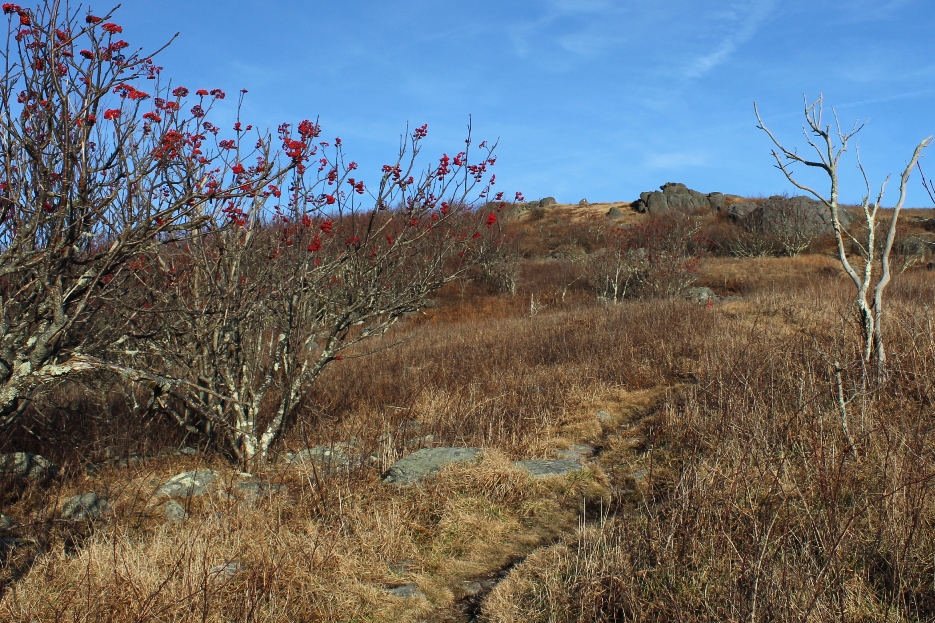
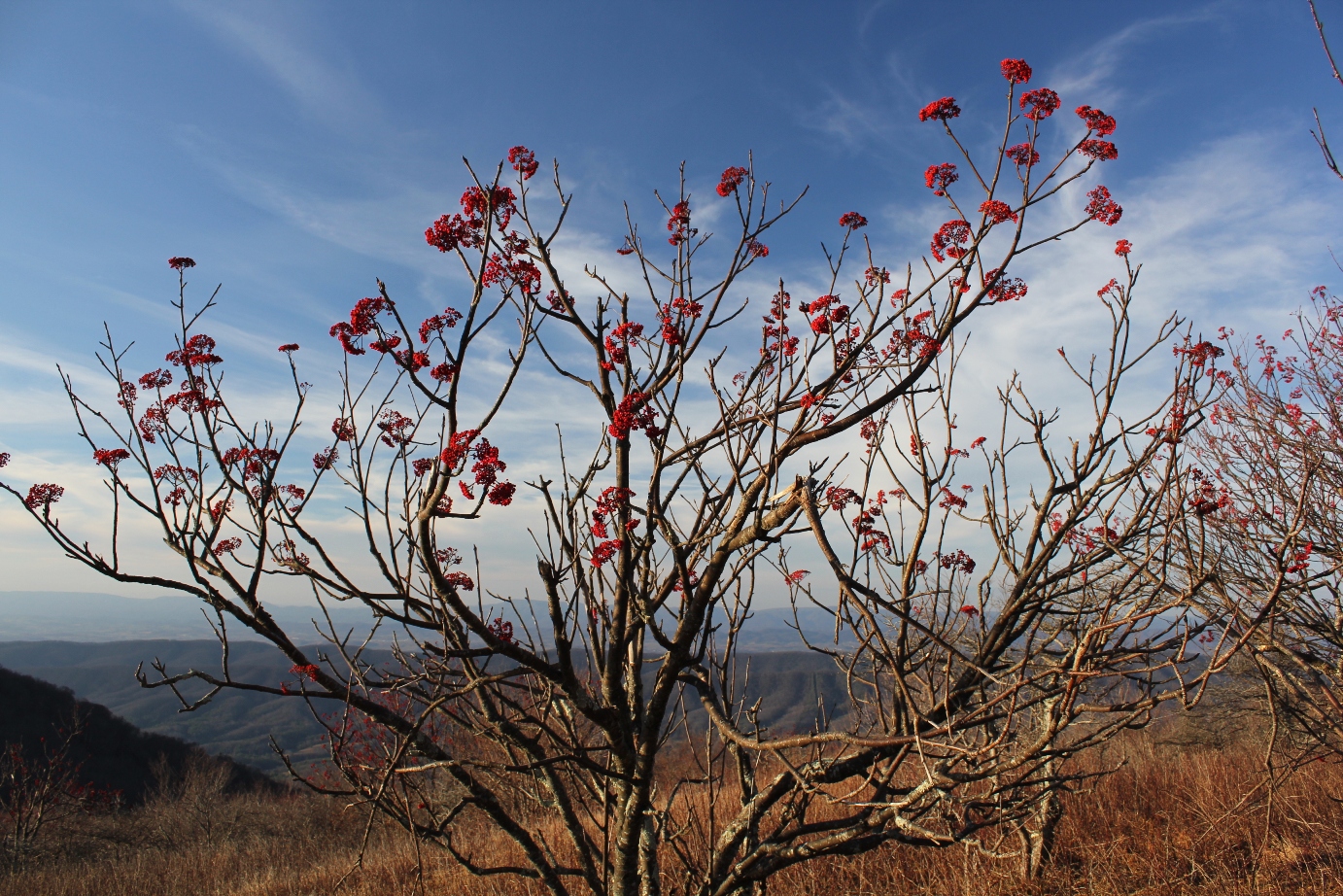
Hawthorn Berries Contrast Against an Azure Sky on Whitetop
This is a staple hike for our family; it’s distance is just about right as a challenging, yet quite doable hike for children. (It’s also a great training hike.) In late November, my son Isaac and I did this out-and-back hike up to Buzzard Rocks, the name of the rocky outcroppings at the base of the bald on Whitetop. The majority of this hike is in the deep forest, but in the last 1/4 you leave the larger hardwoods behind, go through some smaller scrub-like trees, and eventually come up onto the large Whitetop bald that is visible from most high points in Abingdon.
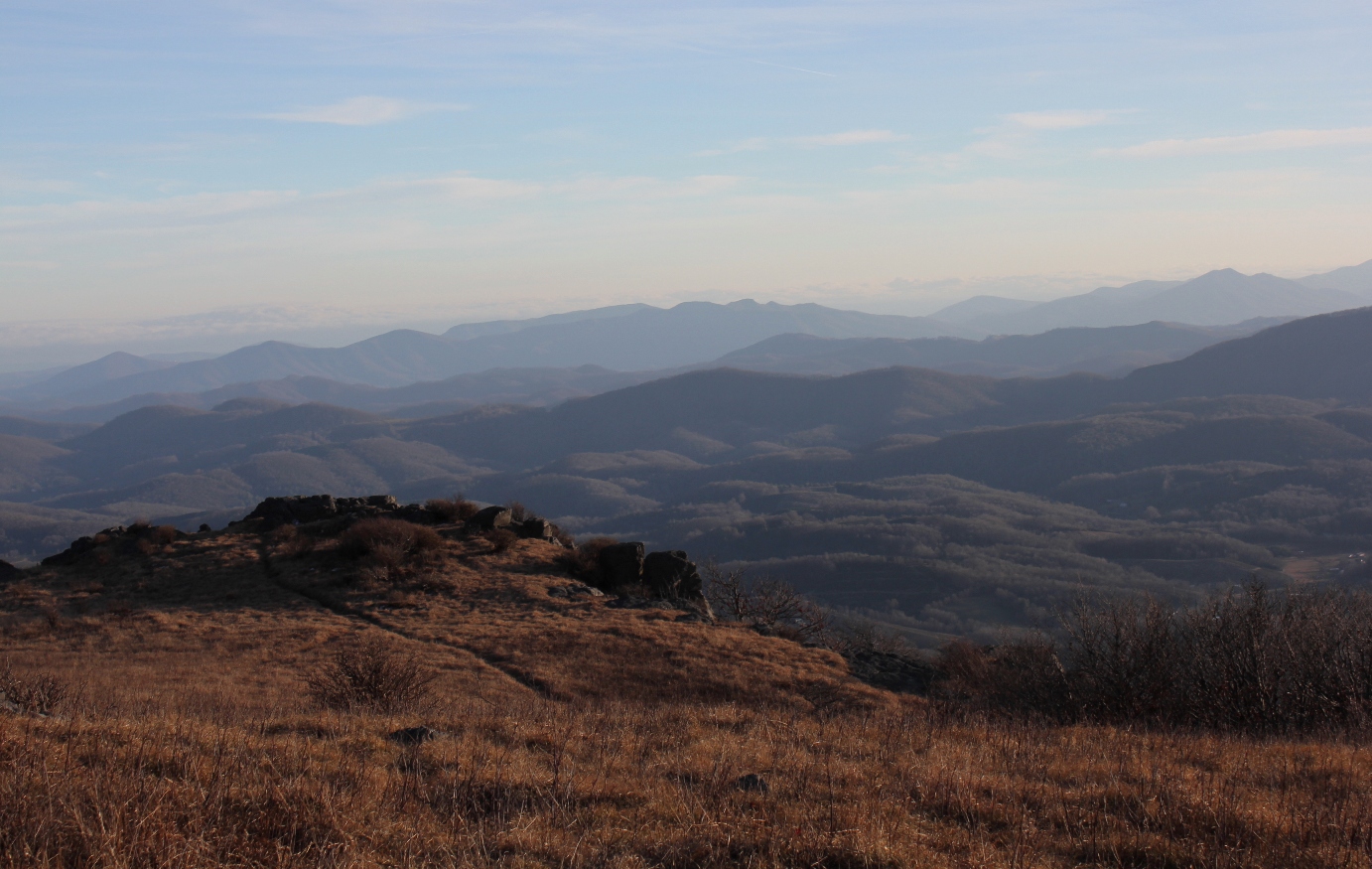
The view from the top of Whitetop is one of the best in Virginia. Here is the classic mountaintop shot from our hike:
Vista from Whitetop
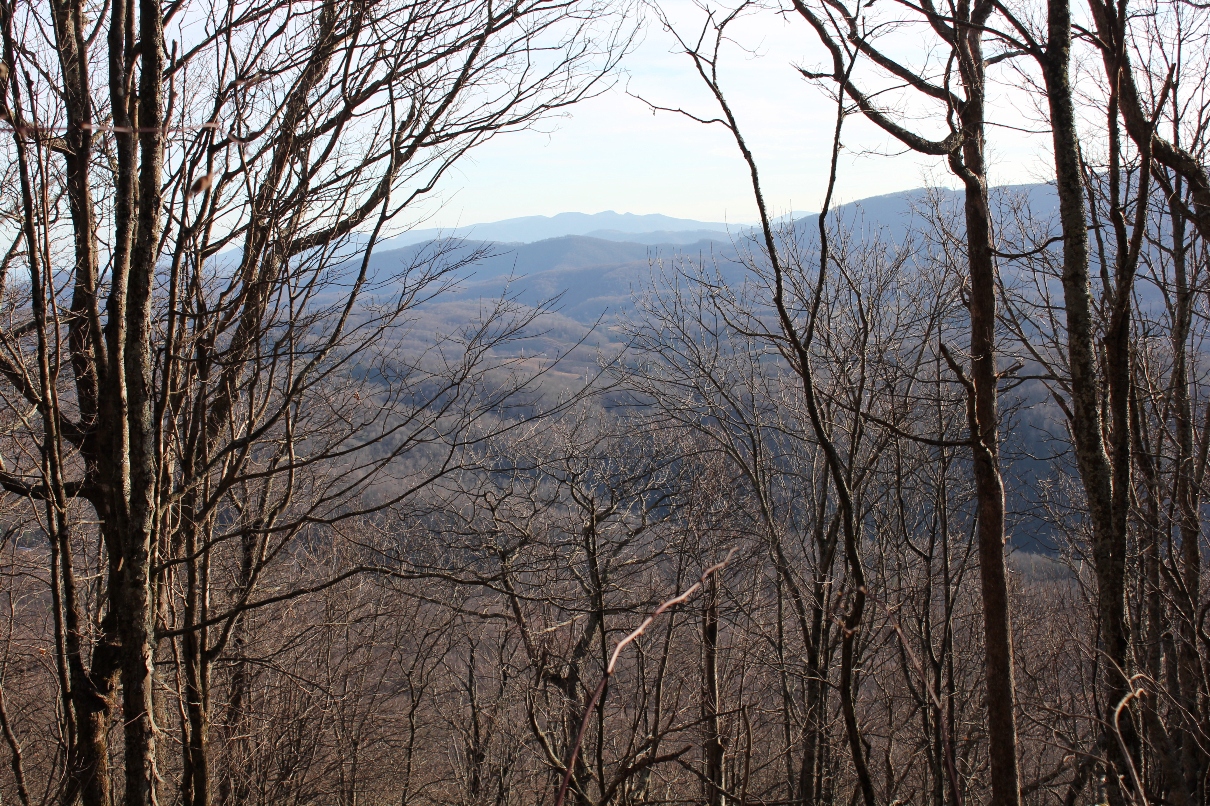
During the summer, this hike can be the quintessential AT walk through a “tunnel of trees” until you reach the very top. In winter, however, you can look up and down the mountain at the various boulders and formations, and you can peer deep into the forest. In the photo below, the leafless canopy affords a view of the top part of Grandfather Mountain in North Carolina. During summer you can’t see this until you get to the balds:
Grandfather Mountain View from the Appalachian Trail Between Route 601 and Buzzard Rocks
Here, you can see the treeline giving way to the balds as my son and dog climb the trail. Note also that there was snow on the trail. It is invariably significantly colder up on the balds than below, usually to the tune of about 20° if there is any wind. It is almost as if you break out into the jet stream.
Emerging from the Trees Below
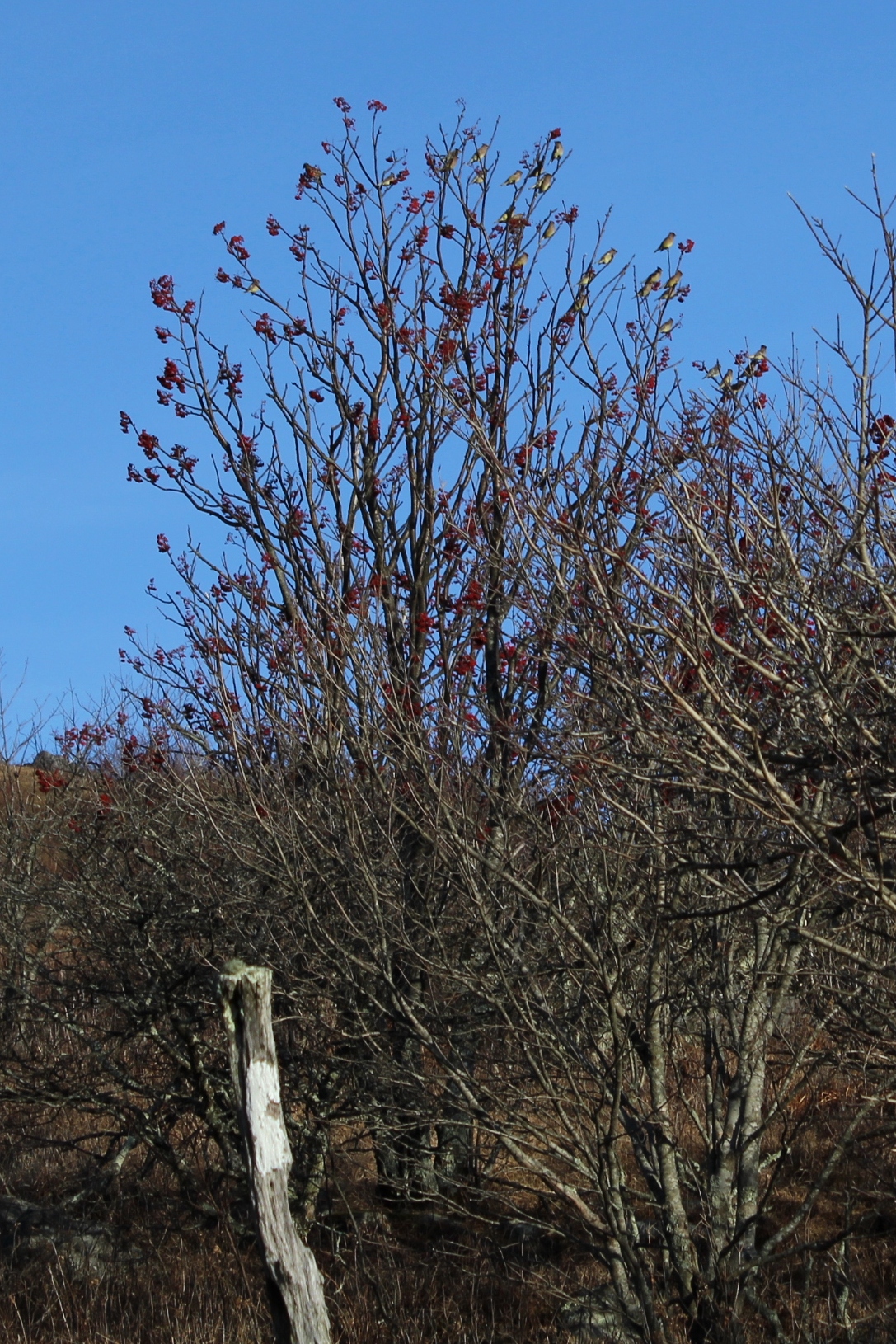
We were treated to a large, migrating flock of goldfinches when we arrived at the bald.
Migrating Flock of Goldfinches on Tall Hawthorn Bushes
The large Hawthorn bushes with their clumps of red berries reminded us that fall was almost over, and the Christmas season fast approaching. Soon similar berries would adorn mantles and wreaths as holiday decorations in people’s homes far below.
Outcroppings near Buzzard Rocks
Hawthorn Bush with Berries Screens View of Iron Mountain and Clinch Mountain
The big-ticket item—the main reason to do this hike—is the fabulous view from the top of Whitetop. The Whitetop bald is one of the largest individual balds in the Appalachian Mountains.
Looking into North Carolina
The vistas are superb from the bald. In the accompanying article, I have put together a panoramic photograph showing how expansive the view is. The photos in this article do not capture how open it is on top of the mountain.
High Altitude Cirrus Clouds Give Way to Long Stratocumulous Cloud on the Horizon
The winds picked up while we were at the summit; I estimated they were in excess of 30 or 35 mph. The ambient air temperature felt like it dropped about 30° from when we were below treeline. We only had on t-shirts, and we began shivering. Fortunately, I had come prepared: Out came the down jackets, the hats and the gloves.
Isaac Thiessen in the Puffy Jacket
It was extremely windy; note in the photo below how the wind has inflated my pants:
Eric Thiessen in the Puffy Vest
The Whitetop hike is not only a fabulous hike; it’s relatively close to home. Coming from Abingdon, you never leave Washington County (except perhaps while on the trail at the summit). At about 23 miles from Abingdon to trailhead, the Route 601-Buzzard Rocks hike is the closest access point to Whitetop and Mount Rogers from Abingdon.
These two panoramic photos taken from a recent trip to Whitetop Mountain show the expansive vista to the southeast at the summit.
If you click on them in an updated browser, they should open in a much larger format that is pretty awesome viewed on 16:9 monitor. There is a slight overlap in the two photographs, but together they form almost a single, panoramic image.
Virginia into North Carolina Panorama
The Blue Ridge in North Carolina Panorama
As I state in the main article, the views at the top of Whitetop certainly justify the climb to the summit.
There is also a gravel road from the east side of Whitetop that goes to the summit of Whitetop. It is Route 89, and it connects to Route 600 near Elk Graden. Route 89 is usually open even in winter, although it is covered in snowpack and requires a 4 x 4.
In Washington County, Virginia, less than a score of miles from Abingdon, is one of the most impressive series of waterfalls in Virginia.
Abrams Falls
This October the owner of Abrams Falls, who is an acquaintance and client of mine, graciously took my son Karl and I for a viewing and photography shoot of the falls.
This is a special place worthy of protection and preservation. It’s almost hard to believe such a natural formation exists on private property, right in the most populous county in Southwest Virginia, unknown to most people who live here.
Front View of Abrams Falls
There is a series of waterfalls here, the major of which is a plunge-type waterfall of about 70′ that continues with a secondary cascade waterfall that drops over a series of ledges for another 15 or 20′. The main falls drop into a large, natural amphitheatre of sedimentary rock that forms a semicircle of 180°. Below the falls, Abrams Creek continues to flow through a 500′ deep, extremely steep, horseshoe-shaped gorge for over 1/2 mile.
Boy in Foreground Shows Scale of the Falls
The size of these falls can be appreciated in the photo above. Note the boy in the foreground on the right of the photo; he is almost 100′ from the base of the falls.
Abrams Falls create their own micro-environment. Mist and moisture at the base of the falls make for conditions that allow certain rare plants to grow.
Abrams Falls – The Main 70′ Plunge
Upper Falls
The falls are located on private property not currently open to the public. There is no road directly to the falls. To get to the falls, one must hike in for about a mile. There is not any developed trail to the falls. There are two semi-trails that property owners and trespassers have used. Numerous trespassers have died or been injured over the years trying (without permission of the landowner) to see the falls.
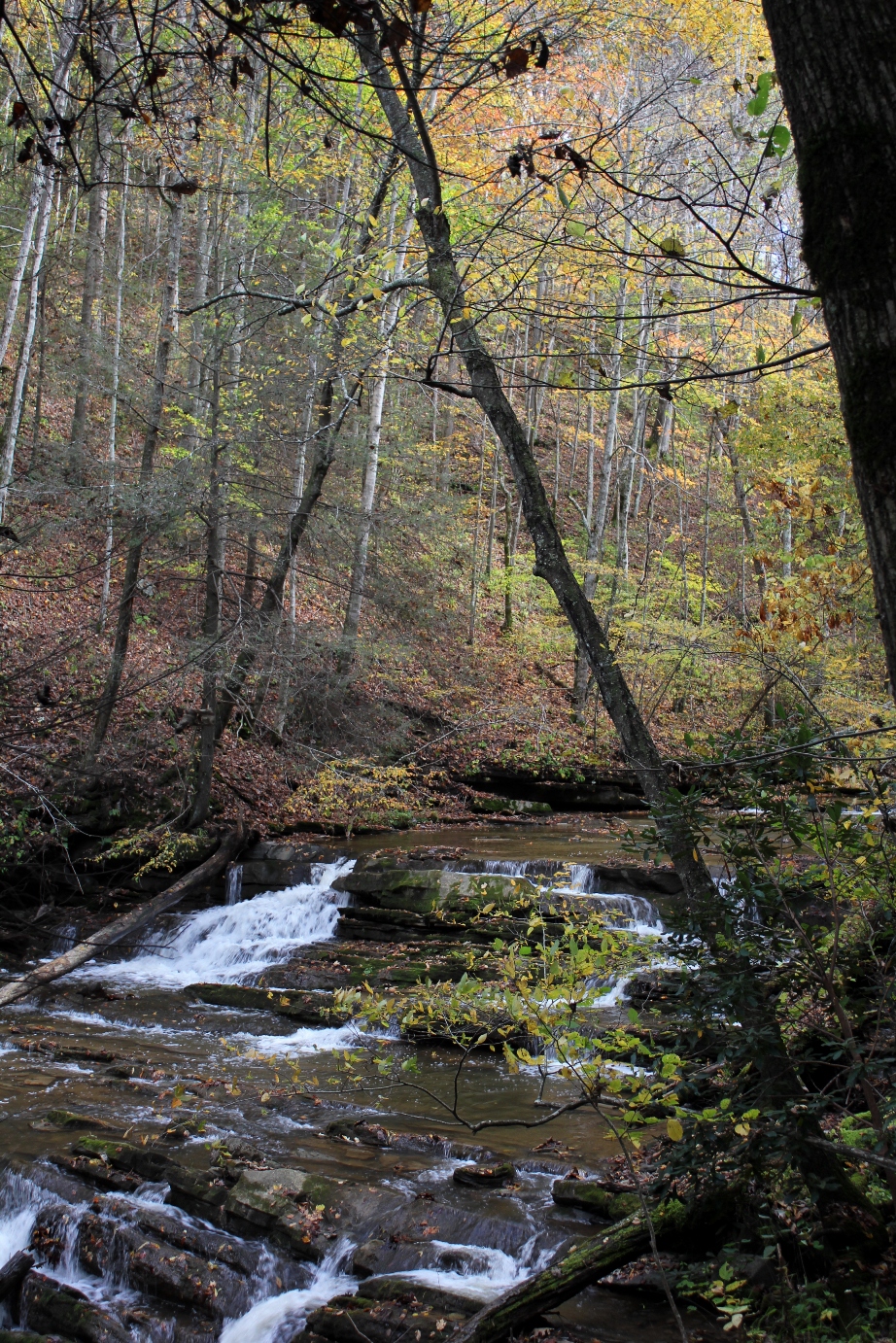
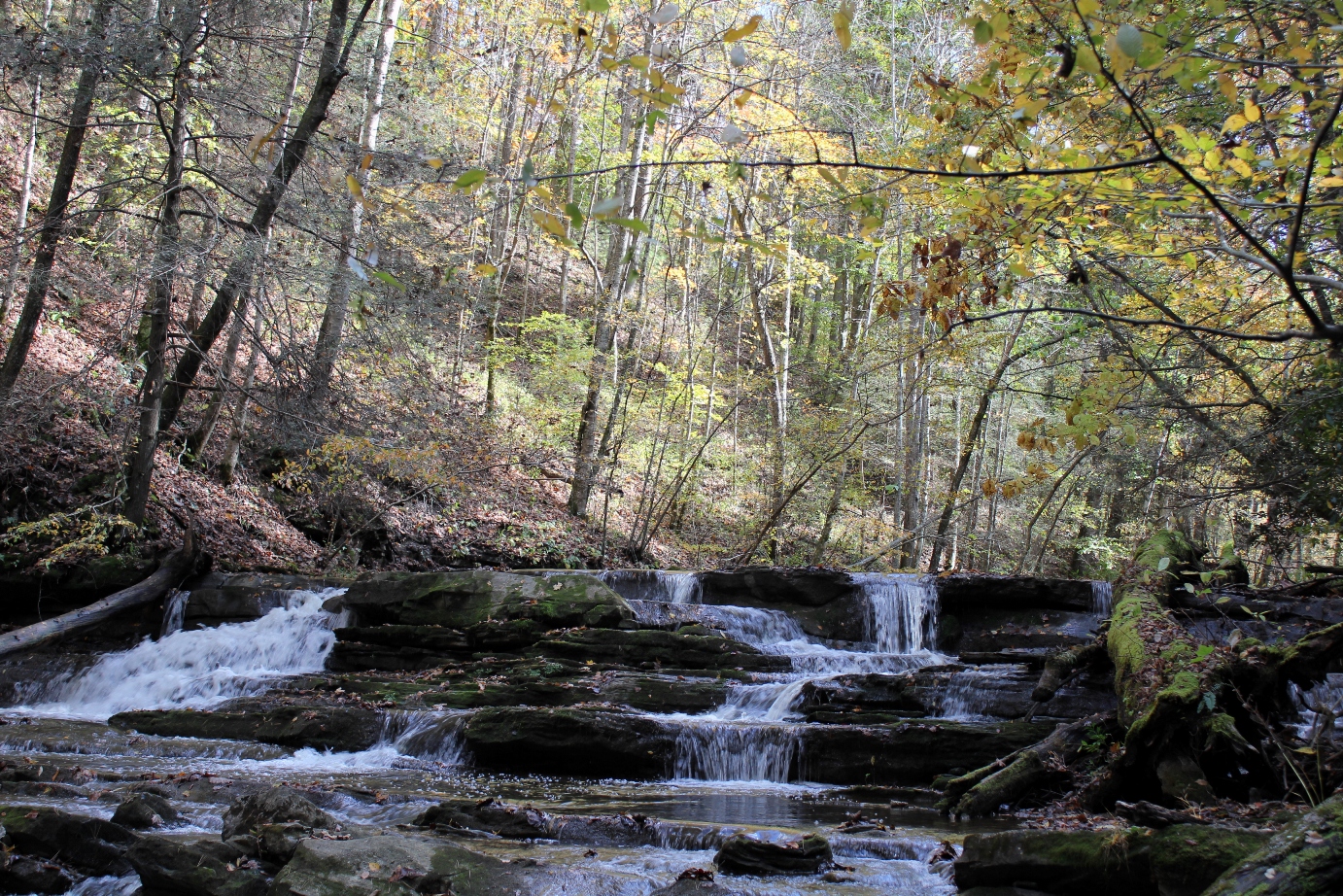
Abrams Creek has several additional noteworthy falls. On our hike, we passed the first, unnamed cataract below. The fall colors were either at their peak, or just slightly past their peak, and made for a great backdrop.
Abrams Falls - The First Cataract
There is another waterfall, I will call it the Upper Abrams Creek Falls, and it is impressive in its own right. It is about a 15-20′ cascade waterfall that spans about 40 feet across. It is at the Upper Falls that the mountains begin to close in to form the gorge.
Abrams Falls - The Upper FallsAbrams Falls - The Upper Falls - The Full Second Cascade
The Gorge
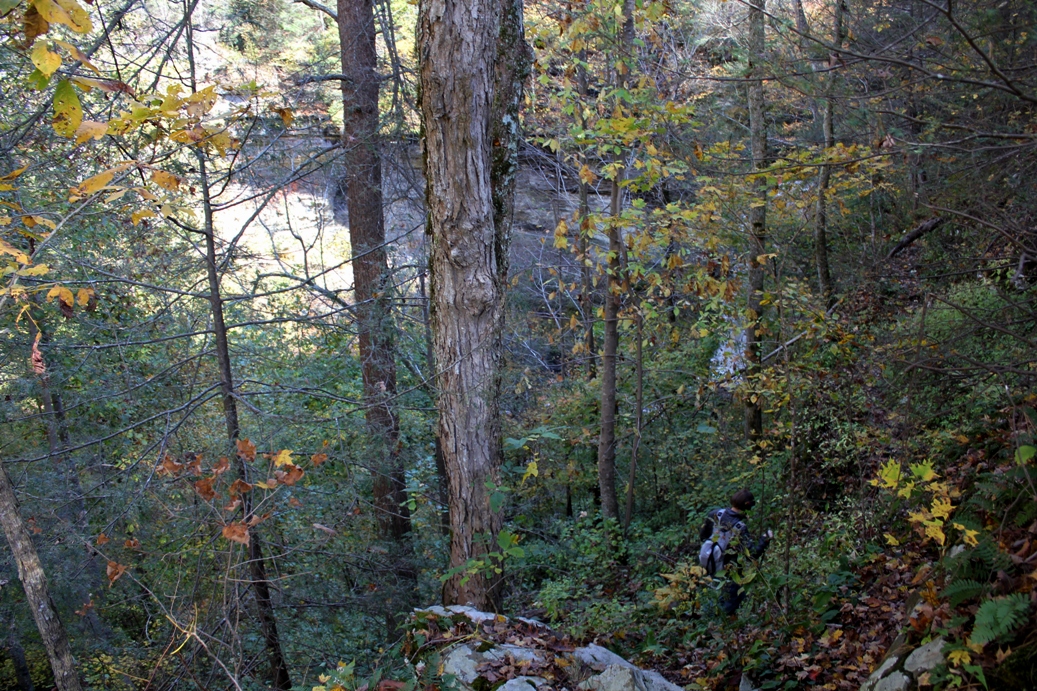
The mountainsides become quite steep downstream from the Upper Falls. Our hike left Abrams Creek at this point, and we began to climb up the mountainside in order to take a safer way to the main falls. This path also allowed us to better view the horseshoe-shaped gorge. The hiking here was strenuous.
The Upper Falls - The mountainside entering into the gorge
The photograph below shows the opposite side of the gorge. This gorge is so closed in that it is difficult to photograph in a way that conveys how steep and deep it is. It reminded me of a miniature version of the New River Gorge in West Virginia, or perhaps even more the Russell Fork Gorge. There are rock outcroppings and cliffs on both sides of the Abrams Creek Gorge. Abrams Creek flows about 500 vertical feet below the highest point of the trail.
Abrams Falls Gorge
We traveled to a point at the top of the mountain that allowed us to view the horseshoe shape of the gorge, and then we began our descent into the amphitheatre where the main falls are located. This descent was quite steep. As we descended, we could hear the ever-increasing sound of the falls crashing on the rocks below. In the photo below, the property owner leads the way down the path toward the falls.
Abrams Falls - Descending into the amphitheatre
The Amphitheatre
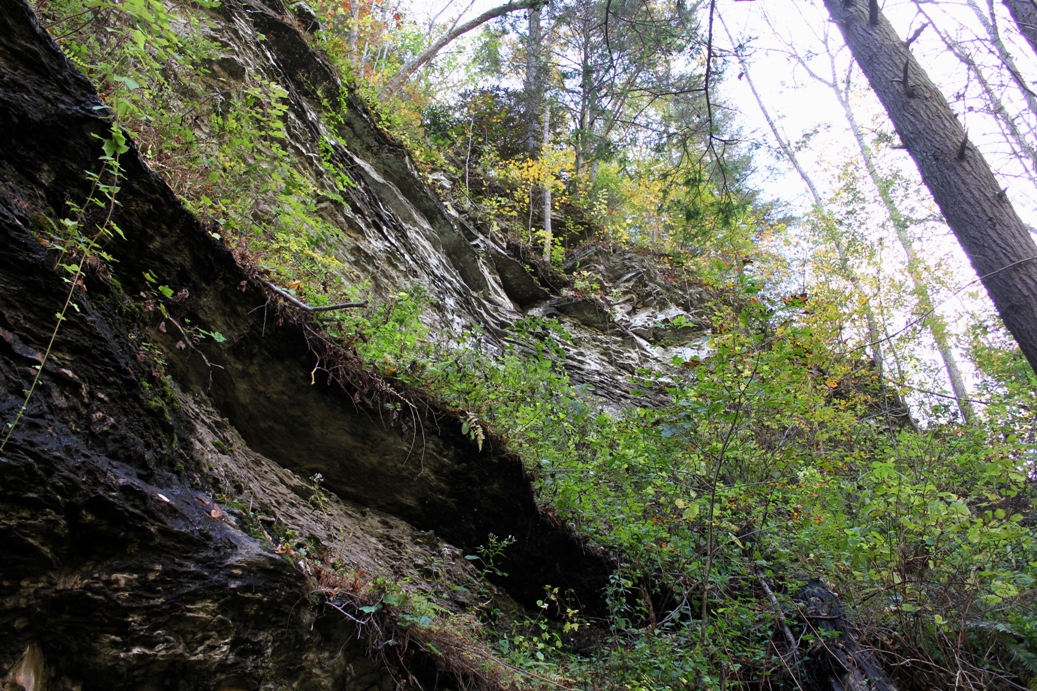
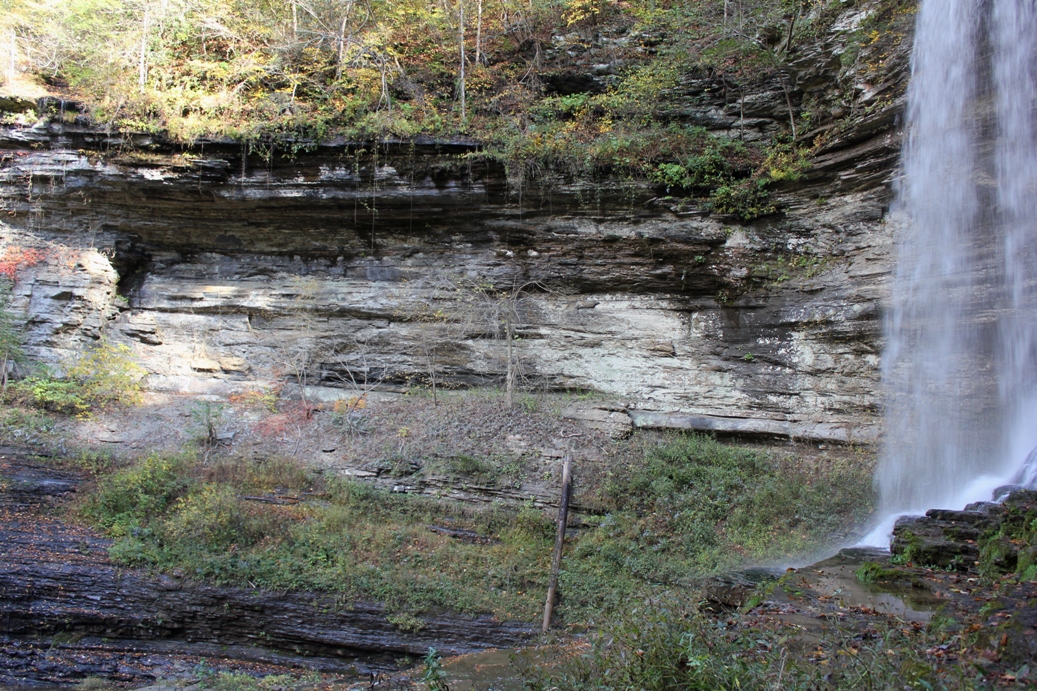
The amphitheatre is formed by 70-80′ cliffs that surround the falls. The photo below is from about 3/4 of the way down into the amphitheatre and shows the steep cliff face.
Abrams Falls Cliff
When there is high water, the force of the creek and the falls must be incredible. In the photo below, you can see a large tree that is up against the opposite canyon wall. This tree was about 35′ in length, and could not have been moved even if we had tried to do so.
There were several large, ordinarily immovable pieces of wood that looked like they had been thrown around down into the gorge. It reminded me of the way you might see random timber lodged against the walls of a Southwestern U.S. slot canyon from flash floods. I would surmise Abrams Creek is also susceptible to flash flooding.
Side Wall of the Amphitheatre
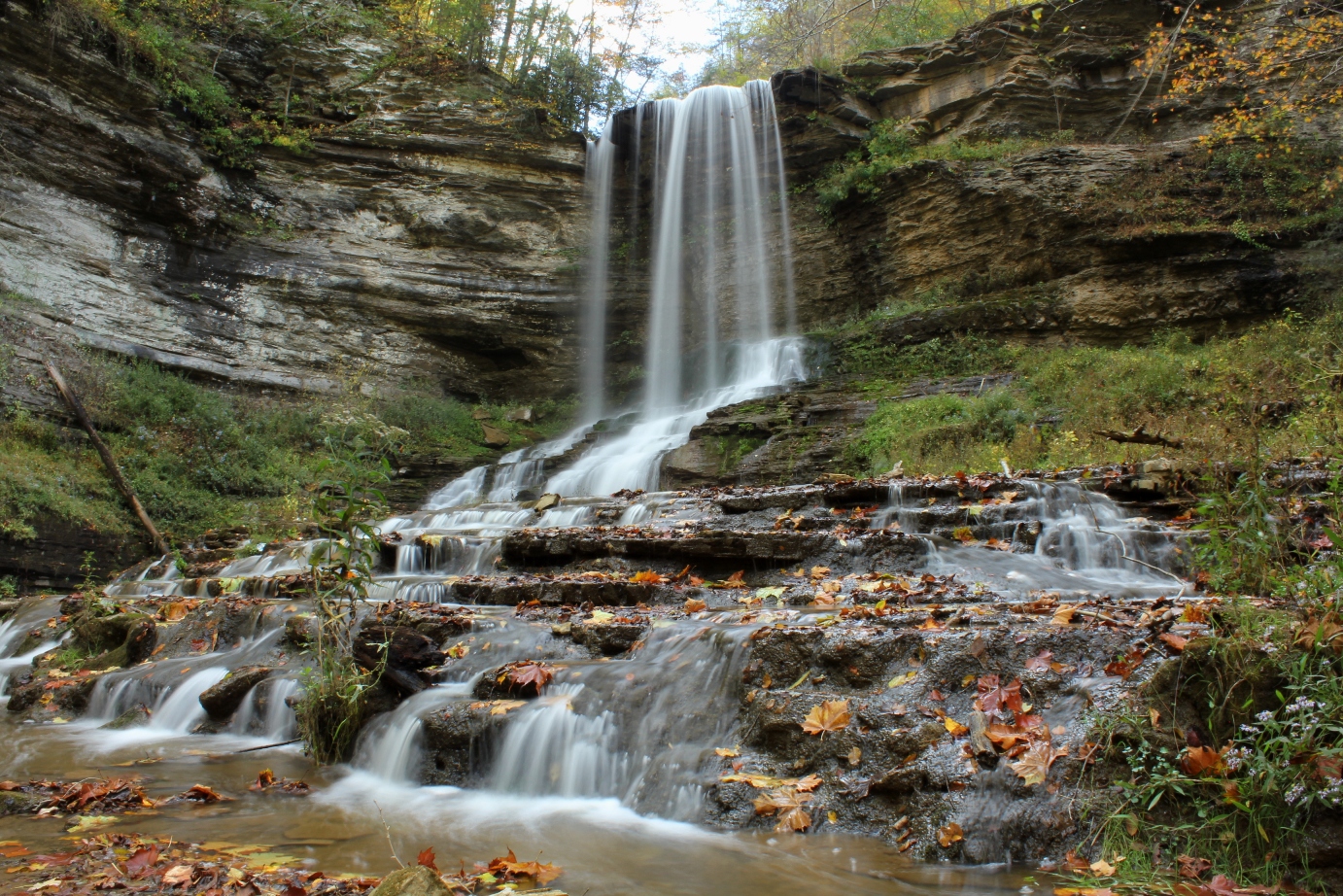
While the main plunge is the central scenic feature, the cascades at the base complement it and complete the falls. In the front-on photo of the falls below, you can see how the cascades spread out beneath the plunge.
Abrams Falls - The Main Lower Cascade
The falls are a true plunge-type falls. Viewed from the side, they look like a bridal veil. There is actually room to get behind the falls, but the rocks are extremely slick, and it would have been dangerous to approach any closer that we did.
Abrams Falls - Side View
The mist from the falls can be felt 50′ from the base of the falls. The roar of the falls at the base of the amphitheatre makes conversation difficult. The whole experience of being at these falls—a completely natural, pristine, and extraordinary place so close to Abingdon—was quite remarkable.
Abrams Falls - Misty Bottom of Plunge
NOTE: The photos here are published with permission of the landowner. Please enjoy these photos, and at this time appreciate this place through them.
These falls are not on public property. It is illegal to trespass on private property in Virginia. This trip and photo shoot was conducted at the invitation of the landowner. The general public is not invited to visit the premises at this time.
There have been fatal and other serious accidents involving illegal trespassers at Abrams Falls. Respect the landowner of this property, and do not attempt to visit the falls unless you have permission.
One of the gems of the Mount Rogers National Recreation Area is Fox Creek. Nestled between the south side of Iron Mountain and the north side of Mount Rogers, Fox Creek flows east through about 5 miles of National Forest before entering private property down the mountainside.
Fox Creek
Lower Fox Creek
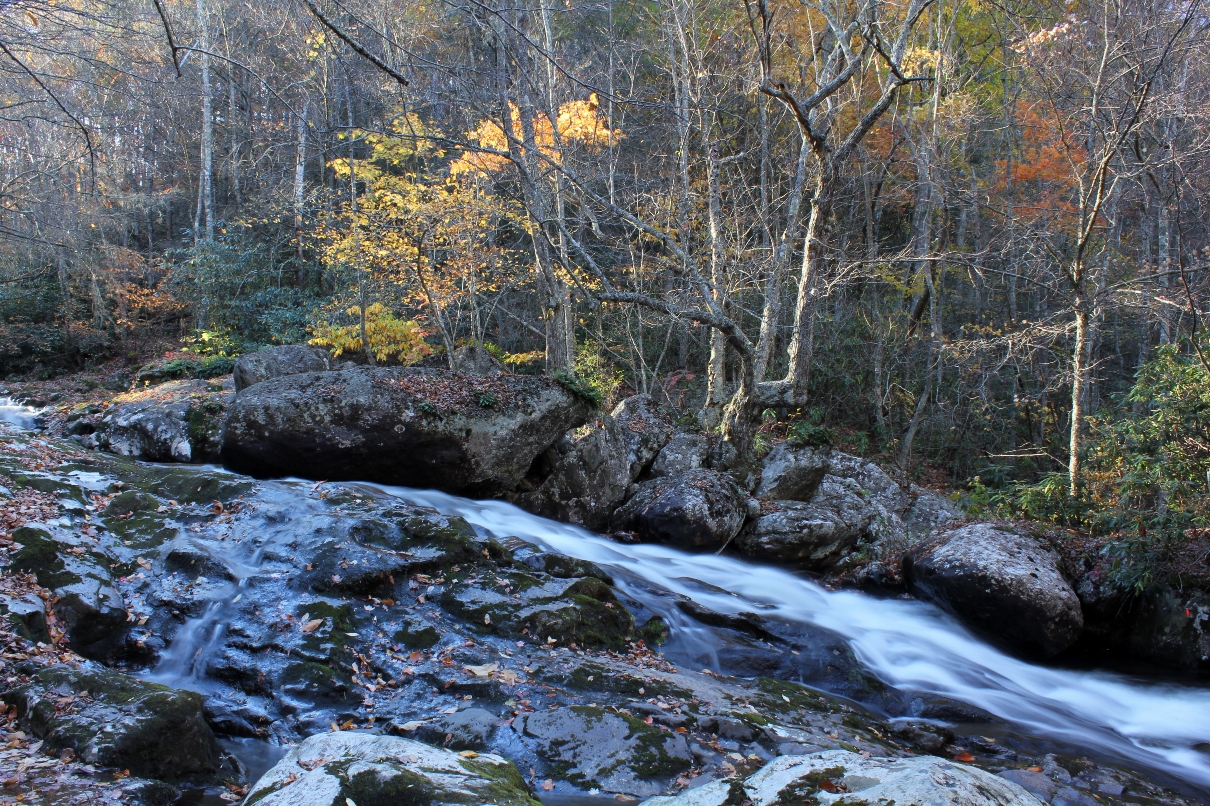
The lower section of the creek that lies within the national forest flows through a miniature gorge. Large boulders and timbers create numerous beautiful pools of water. Fox Creek Falls, a fan-type cascading waterfall, is a much photographed feature. The photo below shows Fox Creek Falls from a side angle, a less traditional view. (Click on any of the photos in this article to enlarge them.)
Fox Creek Falls
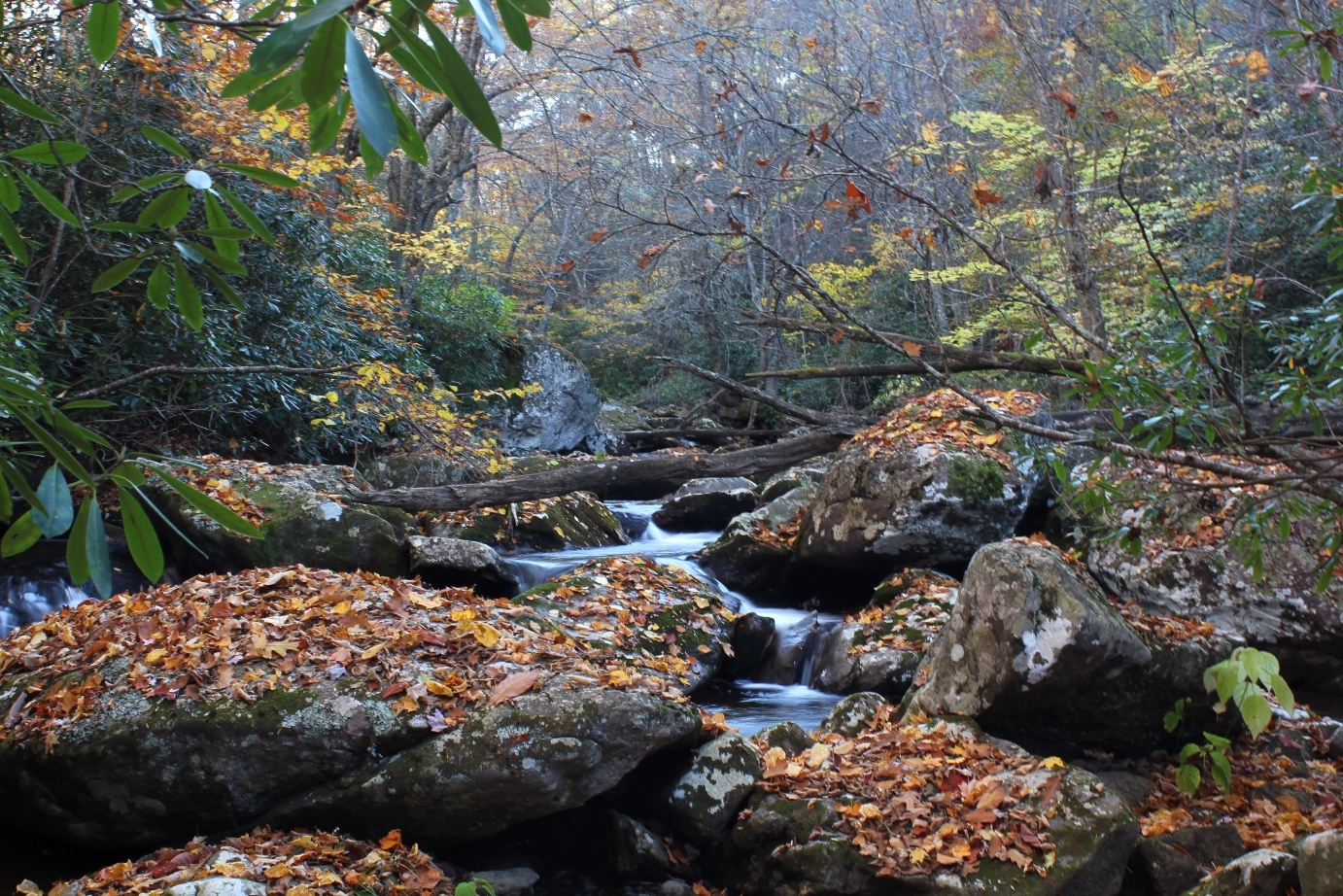
The two trips we took to Fox Creek in October revealed remarkable foilage on the moss-covered boulders. Although past their peak vibrancy, the leaves created a tapestry of color that I needed to capture with the camera.
Fallen Timber and Boulders Create a Striking Foreground
The first day we arrived in the middle of the afternoon. The sunlight was too harsh for good photography, so we came back the next day in the later afternoon. The boulders in the creek are quite large; in the photo below, you can see my son Isaac playing on one of them.
One of the Larger PoolsAutumn Leaves Dress Up Huge Boulders
Upper Fox Creek
The upper part of Fox Creek is formed when Lewis Fork Branch joins the Fox Creek headwater. At this point, the creek becomes a full fledged, albeit small, trout stream. A modest, high elevation valley forms between Mount Rogers and Iron Mountain. The National Recreation Area has a large, split rail fence that runs along Virginia Route 603 for several miles.
Along this section of road is the trailhead for the Mount Rogers Trail, Grindstone Campground, a parking lot for the Appalachian Trail, the Fairwood Horse Camping Area, and the entrance to the unimproved road that goes up to the Scales area of Pine Mountain.
One Entrance to Upper Fox Creek
Fox Creek in this area is a small, swiftly moving creek with a gentle gradient remiscent of a Midwestern trout stream or an Eastern chalk stream as much as typical freestone stream. However, the flow of the creek is variable as it is dependent on runoff from Mount Rogers.
Stalking Wild Trout
The views up and down the valley are Western-like. In fact, much of the Mount Rogers area reminds many people, including me, of the West. It’s like a little slice of the West dropped into Southwest Virginia.
Evening Glow in Fox Creek MeadowFly Fishing for Wild Trout
The large meadows along upper Fox Creek provide many starting points for short hikes. There are also numerous places to begin longer hikes up Mount Rogers or Iron Mountain.
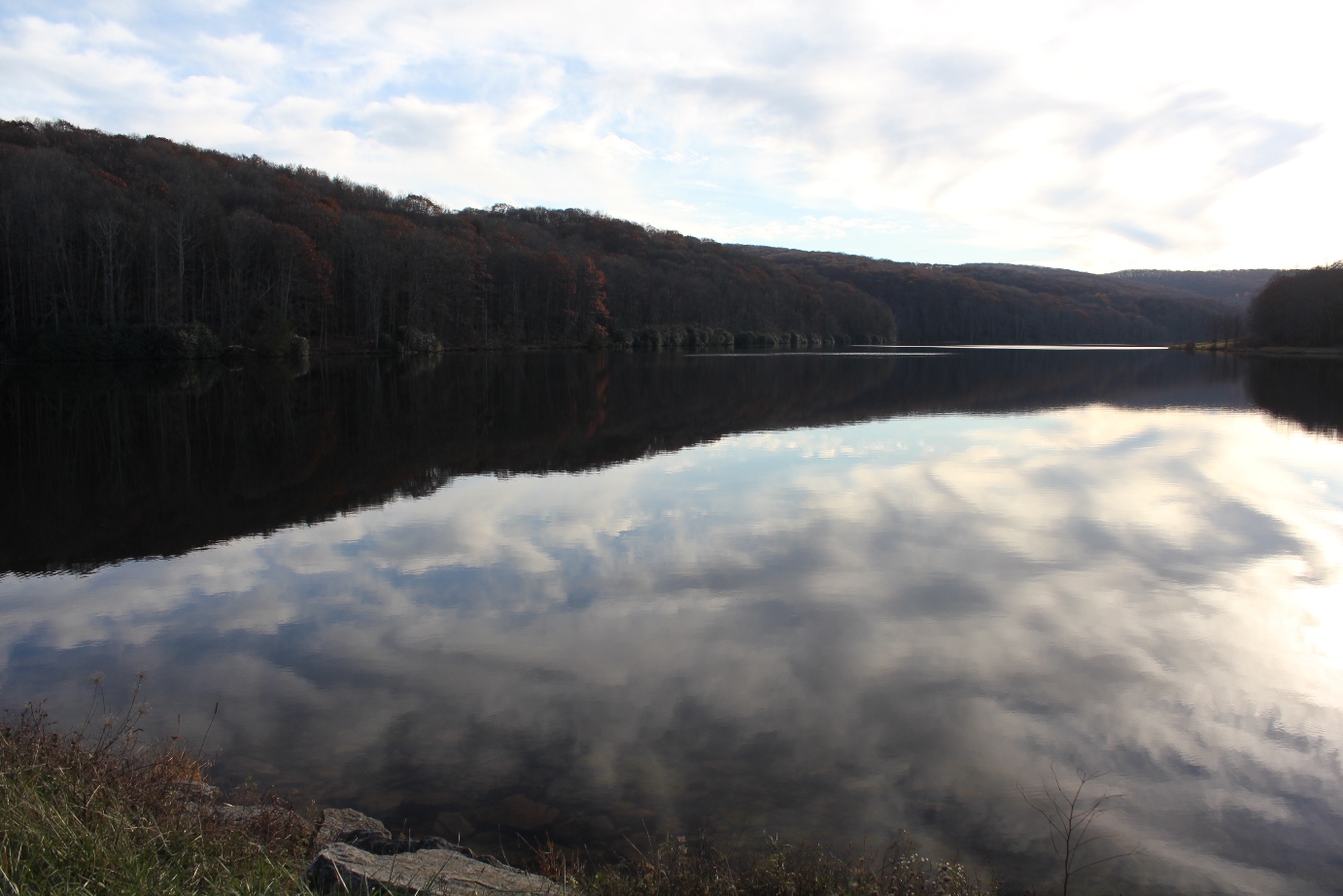
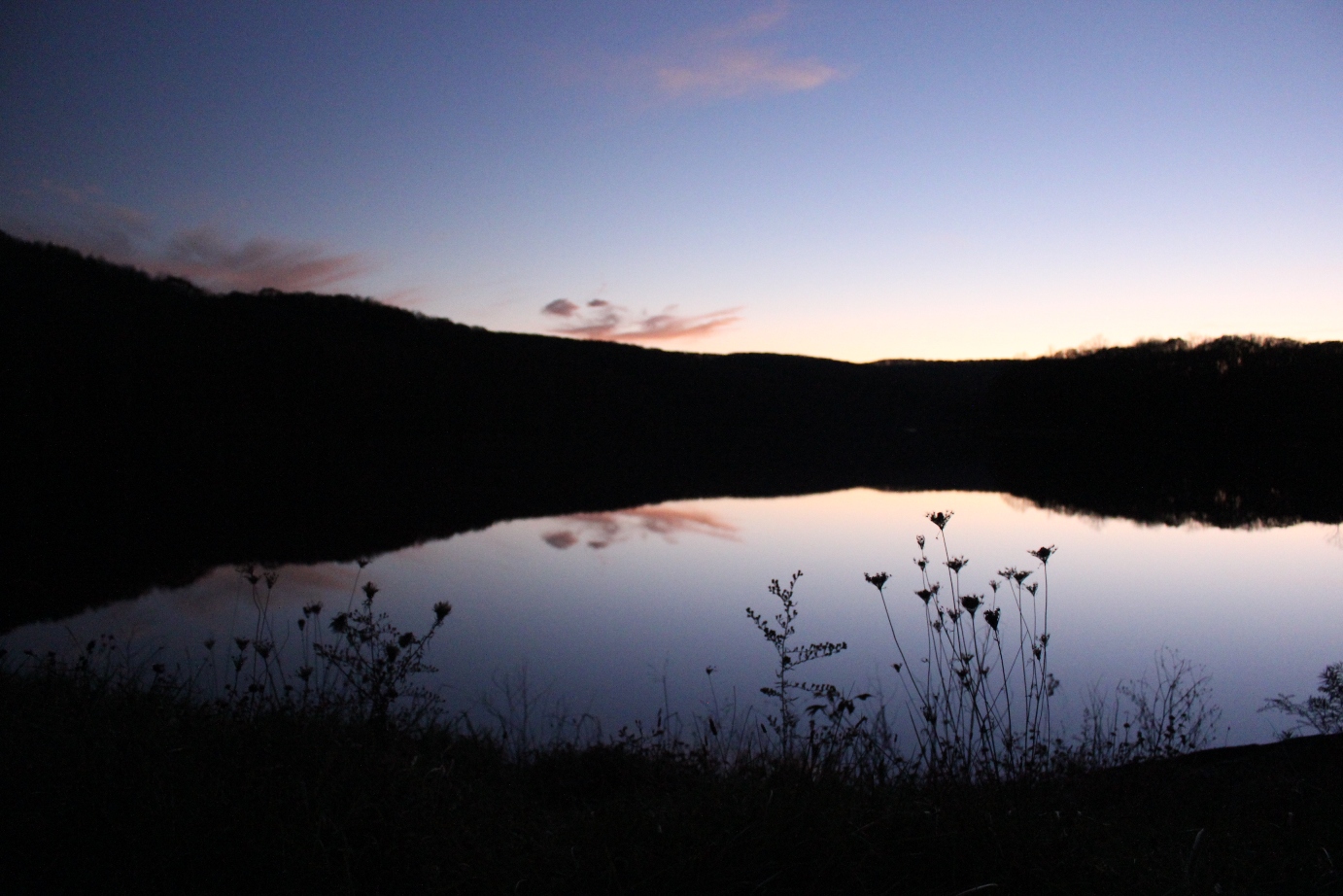
Thanksgiving is tomorrow. During this time we often reminisce and reflect on what’s happened in the past year and give thanks for the good things we have in our lives. Along the themes of reminiscence and reflection, here are some tranquil, reflective photos from a trip my son Karl and I took to Hidden Valley Lake one evening in this November.
Reflections on Hidden Valley Lake
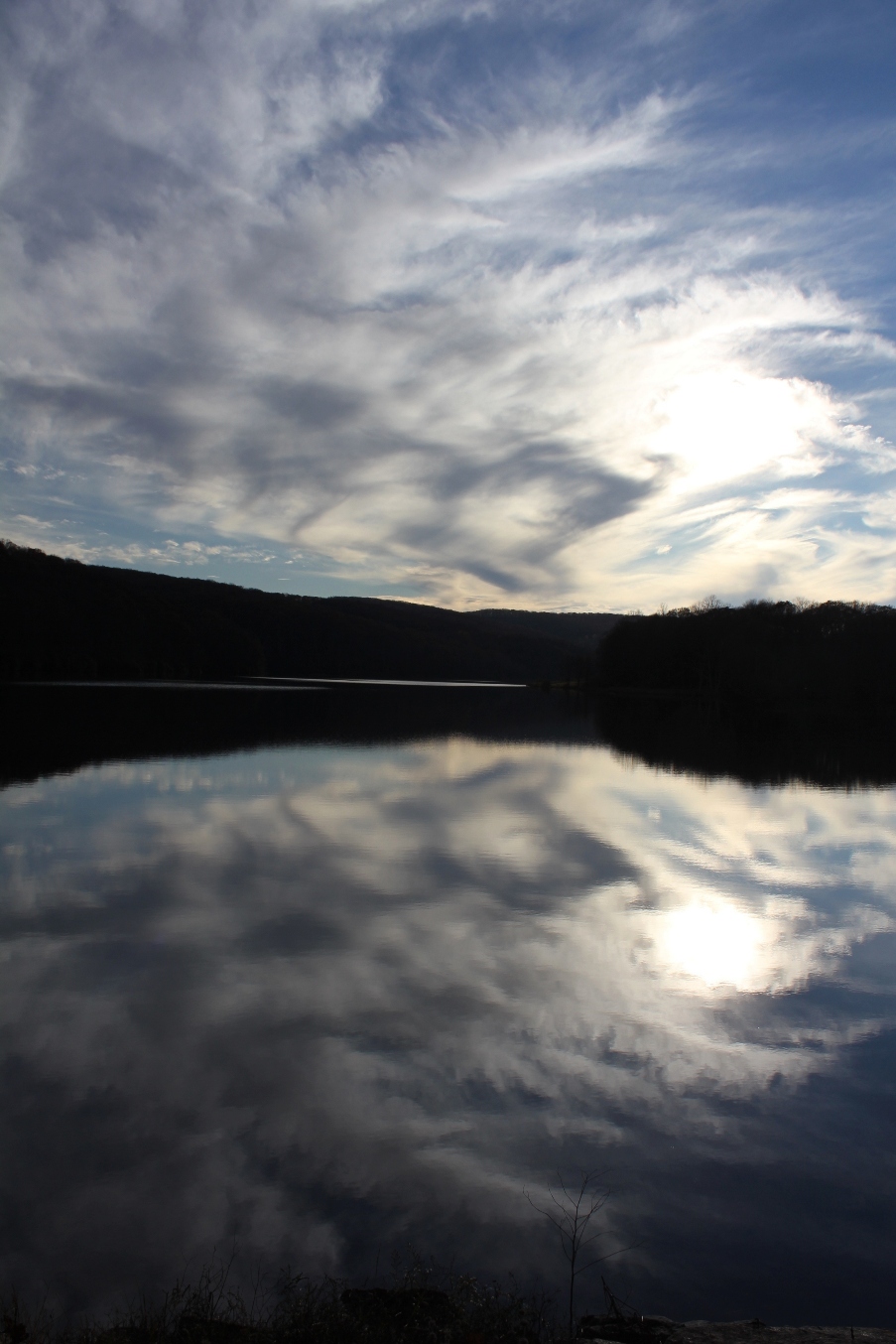
We approached the eastern side of the lake just as a series of interesting cloud formations developed in the otherwise clear evening sky. The lake was very still—there was no wind—and the reflections looking back toward the sun were magnificent. (Click on any of these photos to enlarge them.)
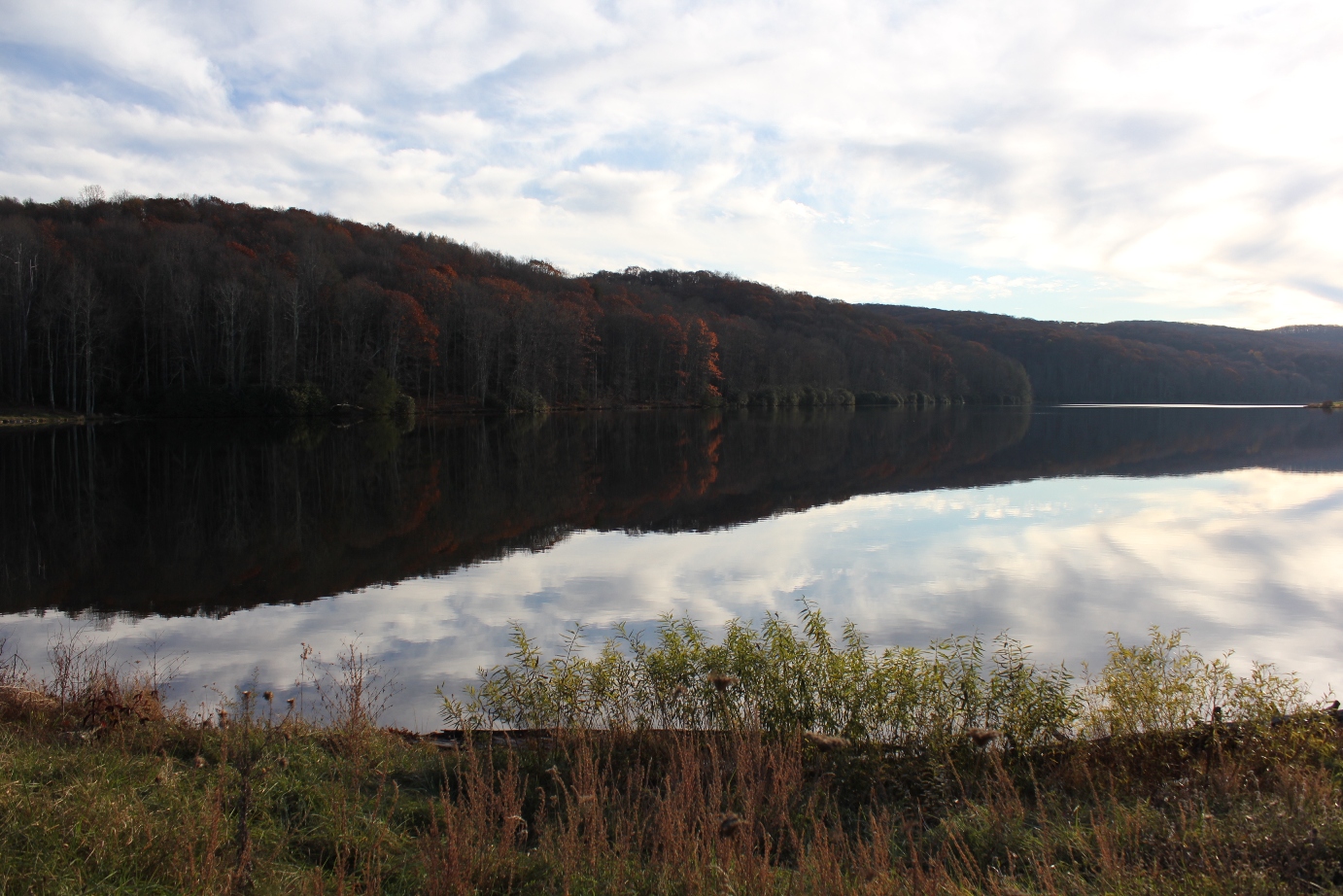
Shoreline Reflections
The leaves had already mostly fallen, but as can be seen in the above photo, there were still oaks on the far side of the lake that clung to some of their dark auburn foliage.
Surrounded by Clouds
We were the only two people in the valley. There was absolute quiet except for the sound of the rushing water in the distance at the dam.
The air was crisp and had a unique, slightly sweet scent. I have since come to learn that Hidden Valley at one time may have been a high elevation bog. There are some unusual plants in the valley that give off the unique scent in the late fall. I have discussed with Virginia Game and Inland Fisheries that it may be Possum Haw aka Shawnee Haw or Nanny Berry, or it may even be the bark from some of the trees after the leaves have fallen and they are more exposed to the air and sun.
Karl and I went for a hike to explore upper Brumley Creek. The creek’s headwaters are formed from the lake’s drainage, high elevation springs, and smaller creeks in the valley.
Upon our return, most of the clouds had rolled away. In the stillness of evening, the lake made an almost perfect reflecting pool. Faint light and muted features caused the scene to look like an impressionist painting:
Reflecting back on this year, I’ve spent a lot of time in the outdoors with my family. That’s one thing, among many other things, for which I am thankful.
Yesterday morning, November 17, we had the first snowfall in Abingdon. It started after I was already at work, so I didn’t get any pictures of it. It only snowed for a couple of hours; it was not a particularly heavy snow, and the ground was too warm for any of it to accumulate.
Unlike many folks, I always enjoy the first snowfall in town, as it means we’re in the season where we’ll see more of it in the mountains as winter approaches.
Snowy Whitetop on October 29, 2011
However, the snow yesterday wasn’t the first this fall in Southwest Virginia. In the eastern end of Washington County we had noticeable accumlation twice in October.
The first heavy dusting occurred on Saturday, October 1, 2011. When we were camping at Grindstone last month (see my previous article), the campground host told me that it snowed all Saturday that first weekend of October, and there was significant accumulation all over the north side of Mount Rogers.
Mount Rogers and Whitetop, Late Afternoon, October 2, 2011
By the time I took the photo above, the weekend storm cleared out, the sun warmed the day back into the upper 50s°, and most of the snow had melted off of the mountains. You can still see some remnants on the summit of Mount Rogers (on the left side of the photo). The scene earlier in the day was more dramatic; it is a strange contrast to see snow on the mountains behind the green, deciduous trees in the valley before they’ve changed into their fall colors.
The last accumulation of snow in the Virginia High Country this past Spring was May 5, 2011 (see photo here). Therefore, even with the relatively mild fall, those who love snow only had to go four months this year–June, July, August and September–before the sight for sore eyes of a white-encrusted mountain top reappeared in Southwest Virginia.
As the sun reflects the autumnal hues of falling foliage, we no longer take the endless days of summer for granted. Our appreciation of the sunlight grows as each day becomes shorter.
The sun bursts through golden foliage in the Mount Rogers National Recreation Area.
Like most natural resources, our conscious awareness of the sun increases in proportion to its scarcity. A whole sunny week is a nice thing. On the other hand, a bright, sunny day following a gloomy, rainy week−now that, my friend, is absolutely glorious!
The warmth of the autumn sun is more palpable in some way, too, and parallels the warm colors of the season. I find myself consciously glancing up to catch the sun’s rays more often in autumn, sometimes as they are cast through the trees.
Grindstone Campground
This past October 15-17 we camped at Grindstone Campground in the Mount Rogers National Recreation Area. This is one of our favorite campsites, and it is somewhat of a tradition that we come here at least once almost every fall.
The elevation, about 3300′, and the climate here usher in a change in the foliage that is usually a few weeks ahead of the change in the towns and cities of the region.
We enjoyed fine fall colors, with the brilliant early reds and yellows across the mountains giving way to the finer and more subtle burgundies and golds of late fall. These are the archetypical colors of Southwest Virginia in autumn.
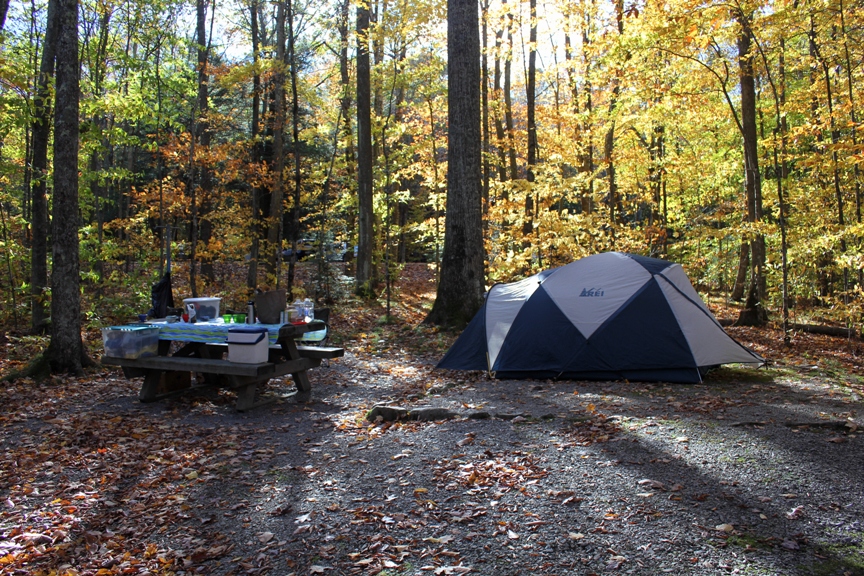
Our campsite was flooded with color each morning and afternoon. The long shadows added texture to the imagery.
Colorful Campsite
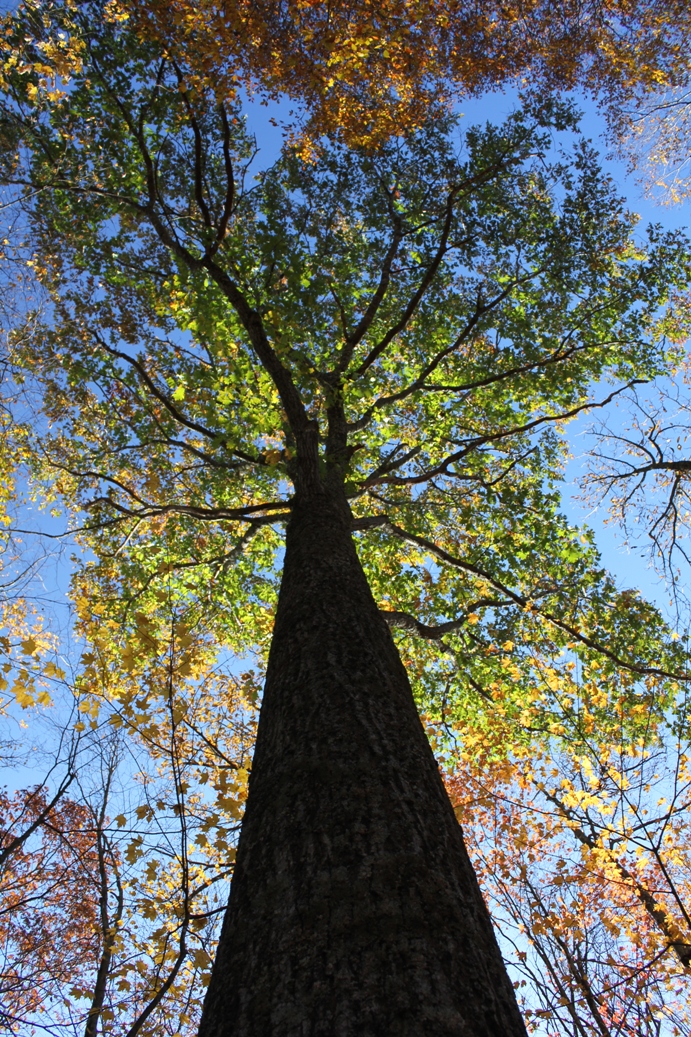
One tall oak, larger than all the others, stood sentinel over our tent, leaves and branches rustling as the wind blew through the campsite all weekend.
The autumn sun and its accoutrements−the colors, the shadows, the warm daylight and accompanying cool, crisp nights−these things make fall my favorite season for camping.
Bigfoot has been sighted in Southwest Virginia. Apparently often. Usually associated with the mountains in the Pacific Northwest, there have been encounters with bigfoot, or sasquatch, all across this country.
Huge Bigfoot Carving in Mt. Shasta, Northern California
Earlier last month, I was finishing a hike with a client when we saw an 8′ tall, fur-covered, man-like creature stop on the trail about 100′ in front of us. Standing but slightly hunched, it turned its head slowly and looked back at us, barred its teeth, and then quickly lumbered away down the hill out of sight.
Neither of us had our cameras ready. It happened so fast we were not able to get a photograph of the creature. Dumbfounded, shocked, and in fear, we just stared down the trail and then back at one another.
Our Encounter
Actually, that’s not what really happened.
Earlier last month, I was finishing a hike with a client when we learned that Animal Planet was getting ready to film a new episode for the second season of the TV show Finding Bigfoot in Southwest Virginia. This is what really happened:
As we were arriving at the gravel parking lot, a large, white SUV drove up to us. The blonde driver stated, “Hi, I’m a TV producer from Los Angeles, and I’m trying to find out some areas to shoot footage for our television show.”
He pointed to where we were hiking. He asked, “Do you know who owns this property?”
My client stepped forward. She said, “I do.”
Then, gesturing towards me, she said, “And he’s my lawyer.”
So our conversation began. We talked for a while, and we learned he was one of the producers of Finding Bigfoot.
Last week, the local newspaper reported that the TV show had a “casting call” of sorts, where they interviewed individuals who believe they have encountered bigfoot in our region. According to the Washington County News:
After a short introduction by the show’s cast, the floor was open for local residents to tell their best Bigfoot stories on camera. Most of the witnesses’ stories had the common theme of spotting an extremely tall, broad-shouldered figure while hunting in the woods. One of the hunters was a man from Piney Flats, Tenn., who told a detailed story about how a large, dark figure with long, matted hair walked up to him, looked at him for a moment, then walked away in a zigzag motion.
“With my hand up to heaven I know what I saw,” the man said after he told his story.
A teenager from Saltville told a story about how she saw the familiar dark figure at the top of a hill outside her home, and soon after she made eye contact with it she was hit by a rock that left a sizeable bruise on her right leg. She even brought in a drawing of the creature to show to the cast.
The Bigfoot Phenomenon
The phenomenon of the fascination with bigfoot is itself fascinating. Like other paranormal phenomenons, such as UFOs, opinions on the existence of bigfoot are polarized. Either you believe they exist, or you think those who do are freaks.
Those who believe in bigfoot argue that bigfoot’s existence without definitive human knowledge is not that far-fetched: There are other phenomena−far larger phenomena−that have existed without human knowledge through the ages. For example, until the last 10-15 years, many of the world’s tallest waterfalls remained unknown to humankind (the 3rd, 5th, and 16th tallest waterfalls were only recently discovered). If such large geographical formations could remain hidden, is it not possible that an intelligent humanoid could covertly exist in remote areas of the country?
Huge Yowie Carving, Queensland, Australia
The phenomenon of bigfoot sightings is world-wide. Individuals around the world swear they have seen the humanoid cryptid. In Europe the creature has been known through the ages as the “Wildman”; in Asia it is known as the “Yeti” or the “Abominable Snowman”; in Oceania it is known as the “Yowie.”
The great climber, Reinhold Messner, spent several seasons in the Himalaya and had an encounter with the Yeti. Messner wrote a book about it, My Quest for the Yeti. Messner ultimately concluded that the Himalyan Yeti was most likely a bear.
Perhaps most, if not all, human encounters with bigfoot could be explained in some similar fashion−misconceptions about what people saw or thought they saw.
Bigfoot Sightings in Virginia
In Virginia, there are several organizations dedicated to bigfoot research. The Virginia Bigfoot Research Organization boasts of “combining scientific methodology with shamanistic awareness in the hopes of establishing peaceful contact.” Based in Northern Virginia, VBRO has a large list of encounters with bigfoot in the Commonwealth organized by region. There are numerous sightings in Southwest Virginia. Sasquatch Watch of Virginia, another organization, “conducts initial field investigations and field research within areas of reported encounters or habitual recurring encounters.”
One website purports to map all of the confirmed bigfoot encounters in the United States. From my review of the maps, there are more bigfoot sightings in the Eastern United States than in the West. There are numerous encounters near New York City.
Which brings us to the penultimate question in this article. Hypothetically, if there are bigfoot in Southwest Virginia, where would they most likely be?
My guess would be up on Clinch Mountain, in the Mount Rogers National Recreational Area, or somewhere near the Virginia-Kentucky state line near Breaks Interstate Park. These are the most rugged areas of this part of the state, where the squatch could reside with fairly large ranging areas and yet hide from humans.
So, is there a squatch in these Southwest Virginia woods? I can’t wait to hear the testimonials on the TV show and find out. And next time you are in the outdoors, be extra aware. Oh yes, keep your cameras ready, too.


























 Abingdon Outdoors