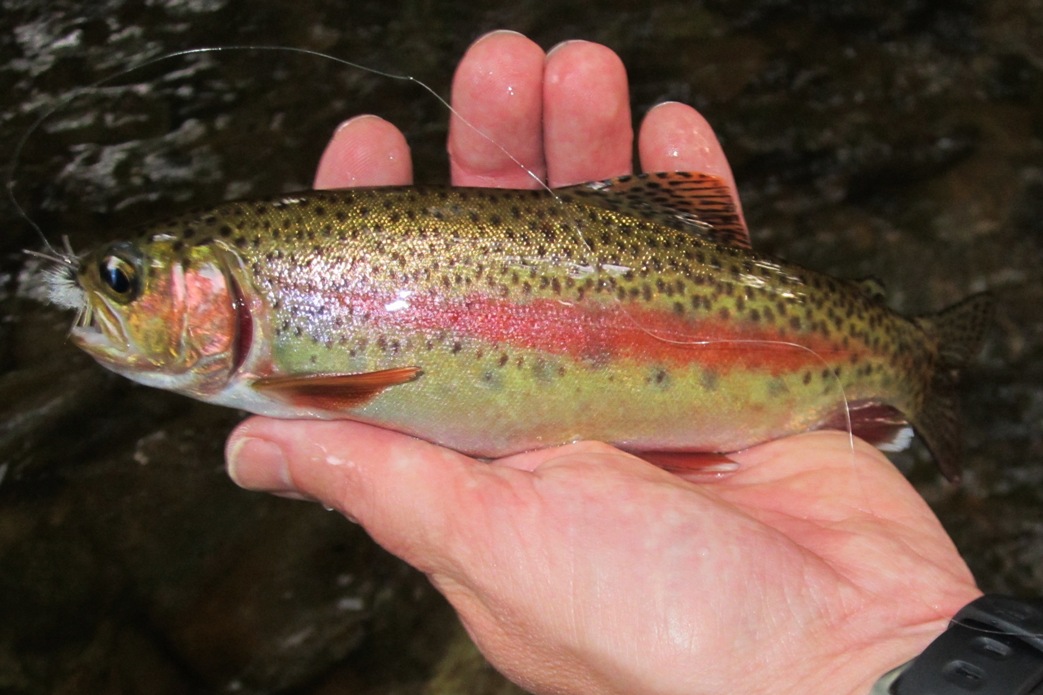
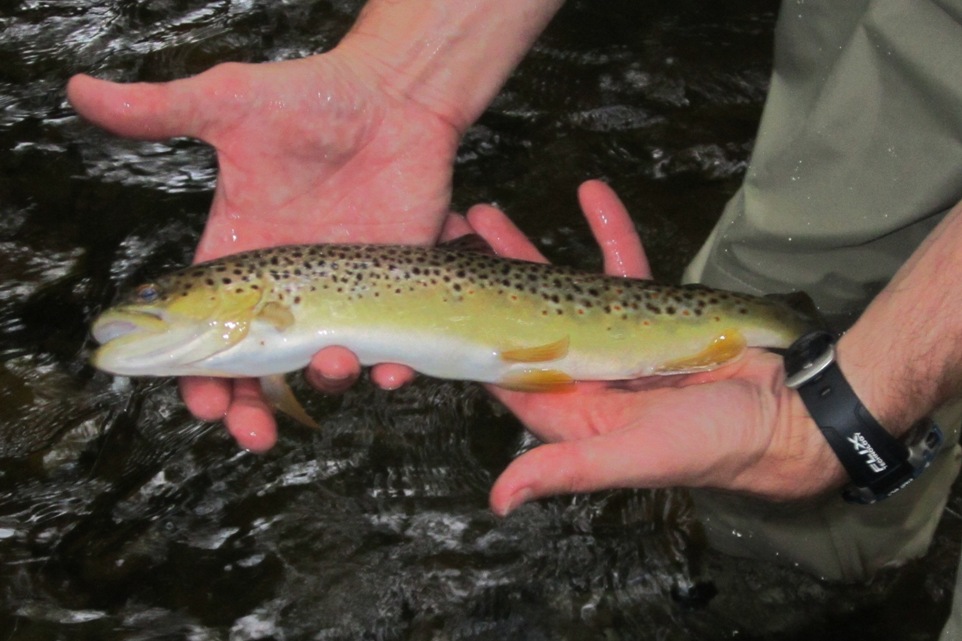
Today my son and I had the rare trout trifecta: We caught rainbow, brown and brook trout in one outing in the same stream in Southwest Virginia. Here are the photos taken with our point-and-shoot camera to prove it:
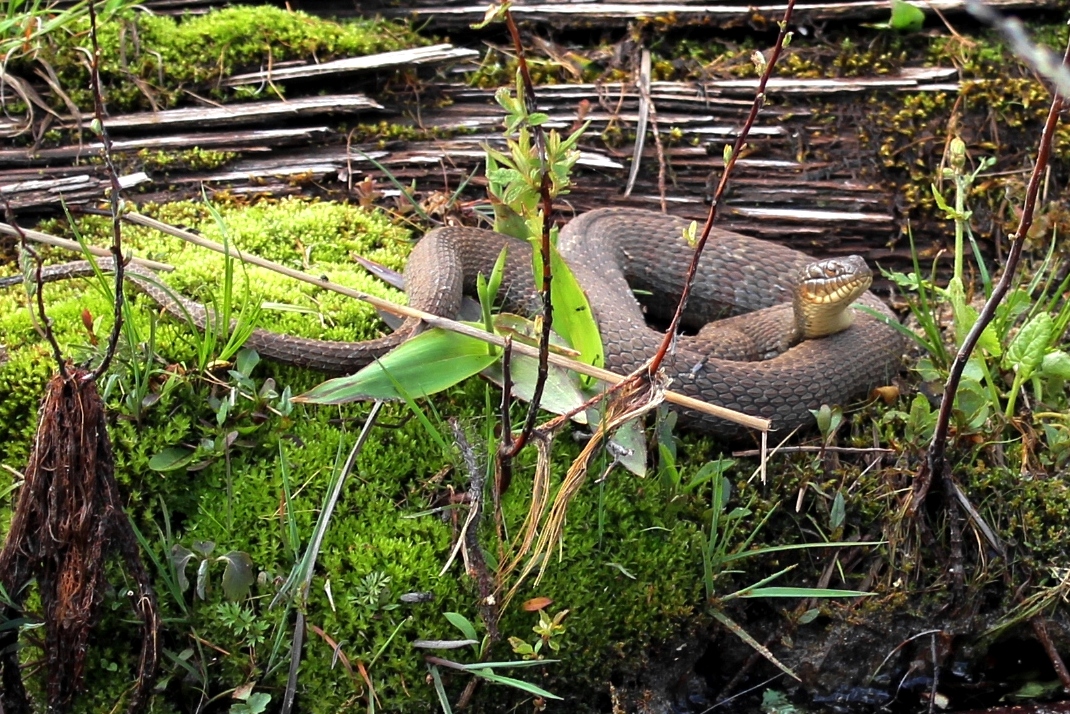
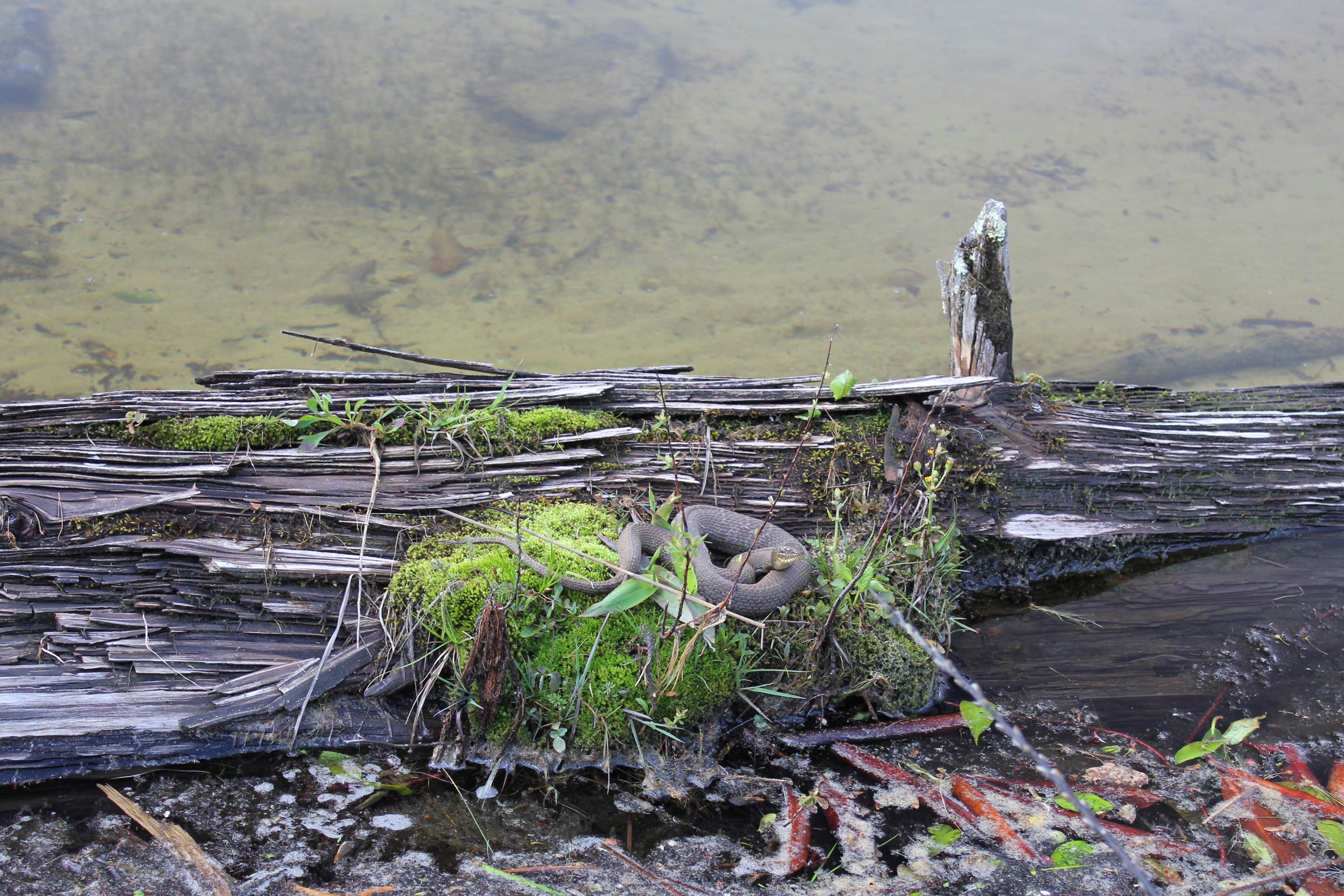
This is a water snake I photographed at Hidden Valley lake a few weeks ago.
Water Snake – Close Up
This photo was taken near the dam on the eastern side of the lake. The snake was almost three feet in length, which based upon the research is fairly good sized for this kind of snake. Water snakes, or Northern Water Snakes as they are sometimes known, are not poisonous but can be aggressive and have a painful bite. They feed on frogs, fish, and other water-based prey. These snakes are found throughout Virginia according to the VDGIF map of occurance for this species.
Here is a photo identifying the major peaks visible from Buzzard Rocks, the outcroppings about 200 vertical feet below the summit of Whitetop Mountain. Buzzard Rocks provides one of the best vistas towards Southwest Virginia, looking back into both Virginia and Tennessee. The small communities of Whitetop and Green Cove can be seen in the foreground.
View from Buzzard Rocks – Click to Enlarge
Buzzard Rocks can be accessed via the gravel road 89 from State Route 600 near Elk Garden, via the Appalachian Trail from Elk Garden from State Route 600, or via the climb from State Route 601.
The pointy mountain labeled 3700′ is Fodderstack Mountain. This is a promentory that divides the valley towards Laurel Bloomery in Tennessee. Tennessee Laurel Creek runs down this valley between Fodderstack and the Iron Mountains towards Damascus.
Between the Iron Mountains and Holston Mountain lies Shady Valley, Tennessee. Beaverdam Creek runs down this valley from Shady Valley towards Damascus. On the other side of Holston Mountain is South Holston Lake, the TVA impoundement that is the largest lake in region.
Between Holston Mountain and Clinch Mountain (which is barely visible on the far horizon) is the great valley that encompasses most of Washington County, Virginia, including Abingdon.
For a comparison, here is another view in the evening from the same vantage point, slightly below Buzzard Rocks.
This article reviews the newest federally protected area in Southwest Virginia, the Seng Mountain National Scenic Area.
Rowland Creek Falls
In 2009 the United States enacted the Virginia Ridge and Valley Act of 2008. Sponsored by Senator John Warner (R-VA) and Rick Boucher (D-VA), the Act preserved over 50,000 acres of wilderness areas in the western part of Virginia. Part of the Act created the Seng Mountain National Scenic Area, a 6,500 acre tract, and the Bear Creek National Scenic Area, a 5,500 acre tract (I will review the Bear Creek National Scenic Area in a future article). See16 U.S.C. § 546b. The designation of these tracts as “scenic areas,” as opposed to “wilderness,” was a compromise to allow continued non-motorized recreational use by cyclists (mostly single track mountain biking).
Some groups and individuals have known about this part of the northern ramparts and mountainsides of Iron Mountain for a long time. The Seng Mountain area has been part of the Mount Rogers National Recreation Area for 25+ years. The scenic area designation simply gives it more protection and makes permanent the designation of the area as one for the limited recreational uses enumerated in the statute. Ok—enough with the legal mumbo jumbo—let’s talk about the area itself:
The area is located in the southern section of Smyth County and is about 30 miles as the crow flies from Abingdon. Its boundaries are roughly Route 600 (Skulls Gap) on the west, Hurricane Campground on the east (off of Route 16), Forest Road 84 near the top of Iron Mountain on the south, and private land near the Stony Battery community on the north.
There are two major single track trails that cross the scenic area, Jerrys Creek Trail on the west side, and Rowland Creek Trail on the east side. Each of the trails follows a small creek that runs down the mountainside. The high point in the scenic area is Round Top Mountain, 4626′.
Mountainsides Draw Close Together to Form Miniature Gorge
In mid-April my family and I drove to the upper trail head of Rowland Creek Trail. Our starting point was at 3850′. You reach this trailhead by traveling on FR 84, which is a gravel forest road. Getting to the trailhead from Route 600 takes about 20-25 minutes.
This is an unusual mountain hike, in that the hike starts the top, so you start hiking downhill, and return going back uphill. Rowland Creek trail starts out wide as it descends around Seng Mountain, down towards the headwaters of the creek below. The area forms a mini-gorge, as the mountainsides are steep and drop quickly down into Rowland Creek.
Rowland Creek Trail - Steep Switchbacks
Where we started, on FR 84, there were no leaves. However, within a half mile of going down the trail, we descended into the foliage of springtime. The protection of the gorge-like formation protects the trees below from the elements, creating a micro-climate that is much milder than at the top.
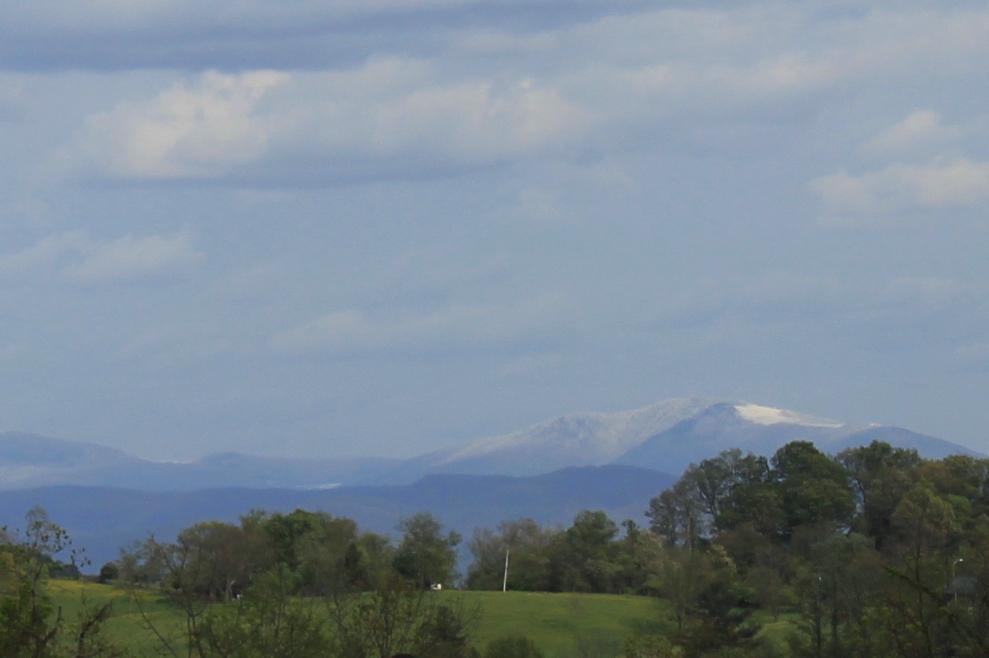
Leafed Out Trees Below Contrast with 4000'+ Bare Ridge Lines
After several switchbacks, you arrive at the headwaters of Rowland Creek. There are some nice potential campsites at the upper end of the trail, within easy walking distance of the creek.
Moss Covered Rocks and Boulders Photo by Karl Thiessen
One thing we noticed is that the trail was quite moist and rutted out from horses near the creek. It is probably extremely muddy after rains. The trail roughly parallels the creek the rest of the way down the mini-gorge.
The area along the creek is lush. We spotted numerous flowers. A bit of research shows that the trilliums we saw are native to the Southeastern United States, particularly in mountainous, gorge-like hollows such as that on this trail. They bloom in April or May at the earliest, while sunlight reaches the forest floor before the trees are fully leafed out.
Southern Red Trillium Photo by Karl Thiessen
One thing we were not anticipating, but had some fun with, were the creek crossings.
Rowland Creek Crossing Number 1
While none of the creek crossings were too difficult, we were hiking after several dry days. The trail could likely become completely washed out, and the creek crossings more difficult (at least to get across without getting soaked) under wetter conditions.
Rowland Creek Crossing 2
Even our dog, Magnus, was enjoying the creek crossings (here is creek crossing 3):
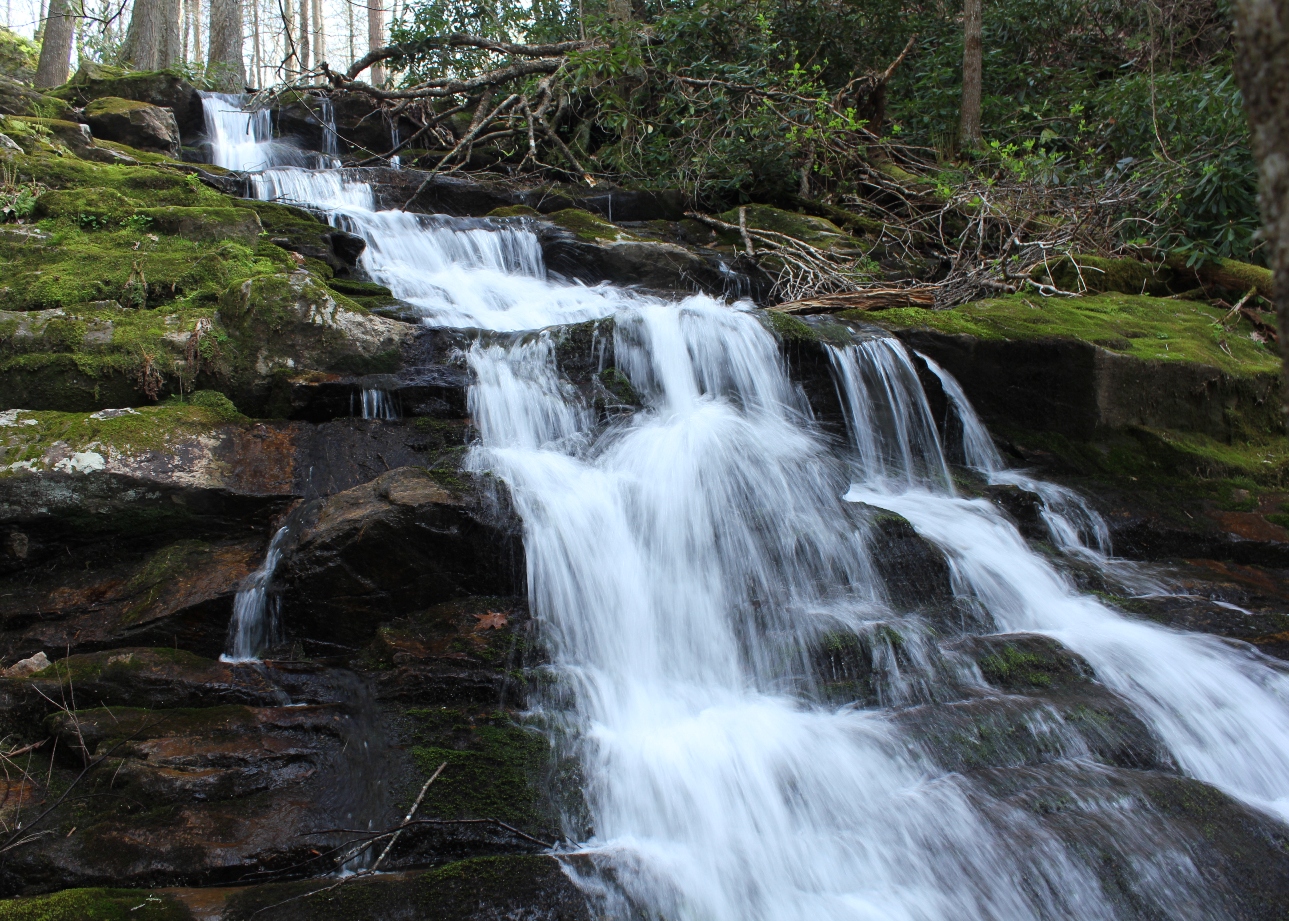
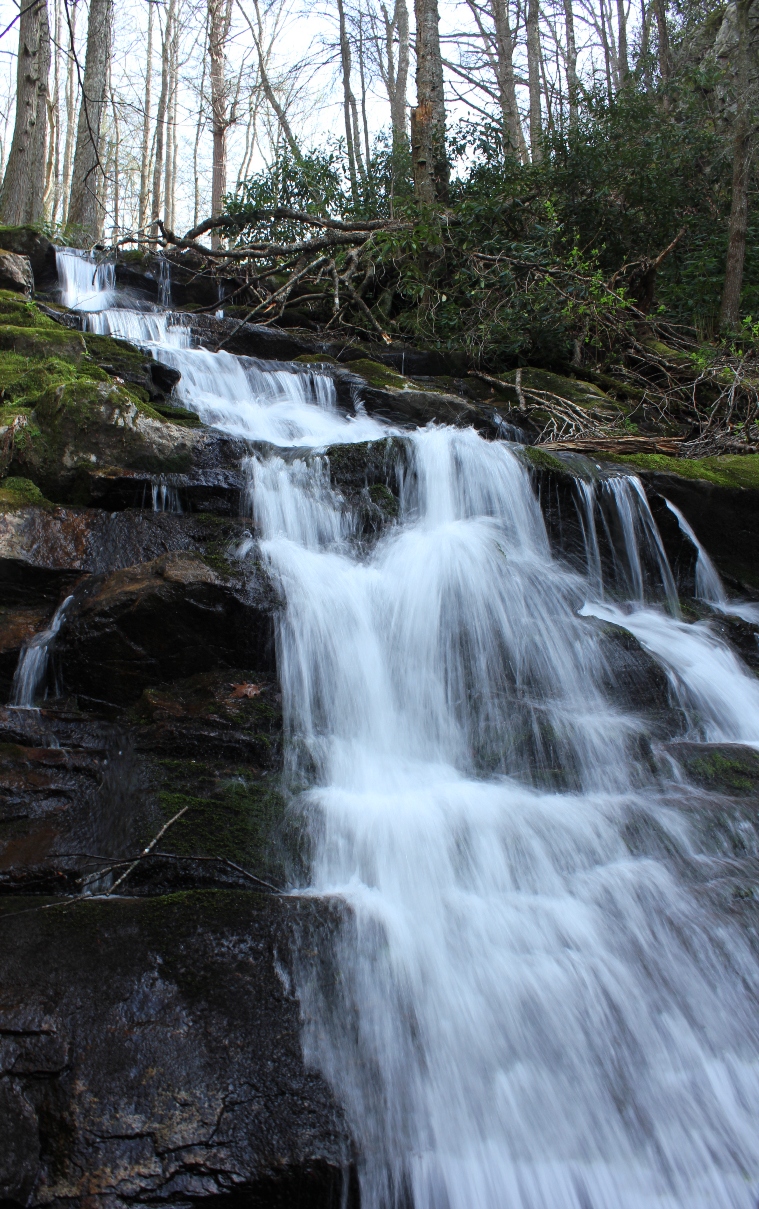
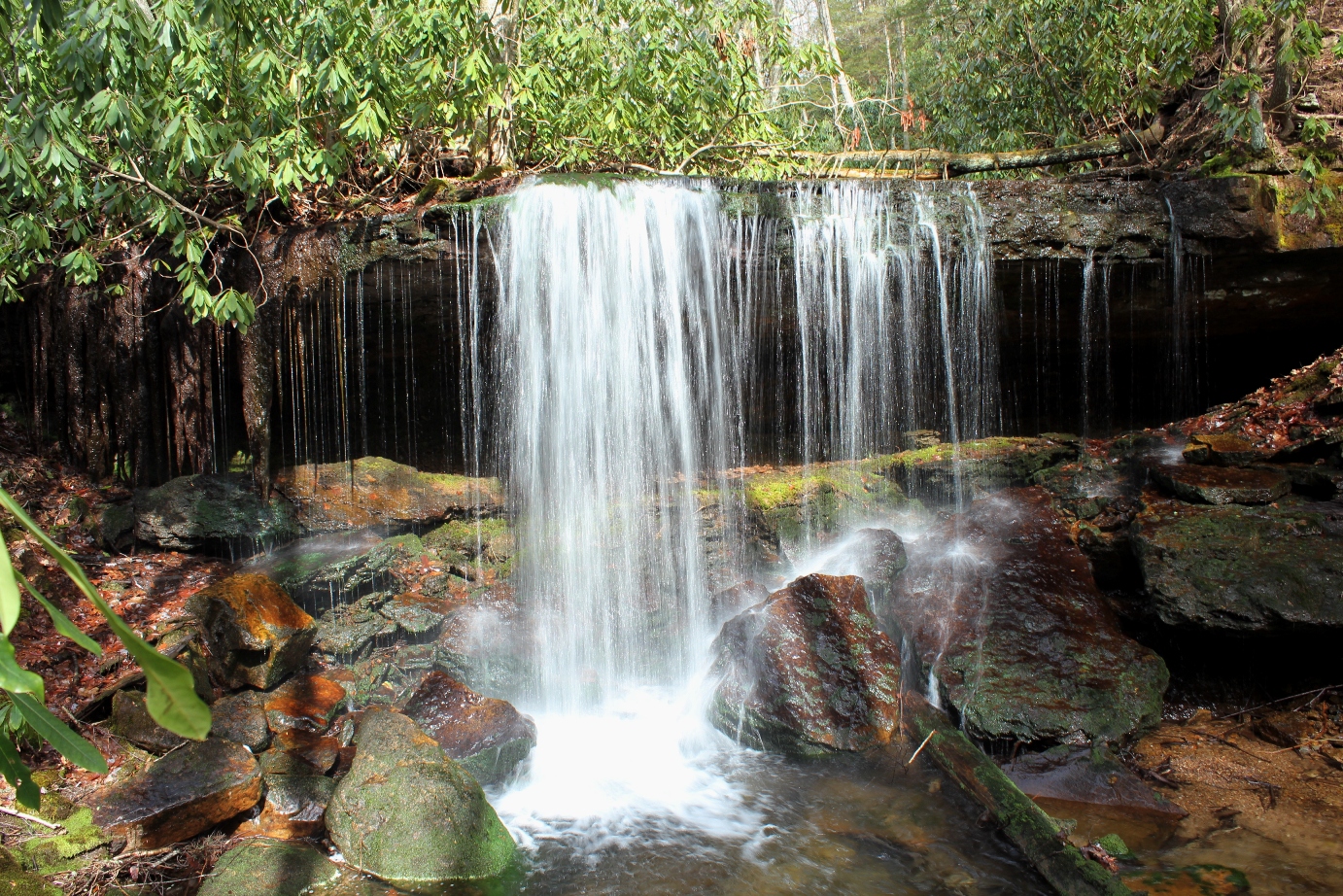
The highlight of this trip is most definitely Rowland Creek Falls, a 50′ cascade-type waterfall that drops down a series of stairs for about 80-100′.
Upper Rowland Creek Falls
The falls are not directly on the trail, so we needed to go down a hill in order to get some clean shots of the cascades.
Multiple Cascades
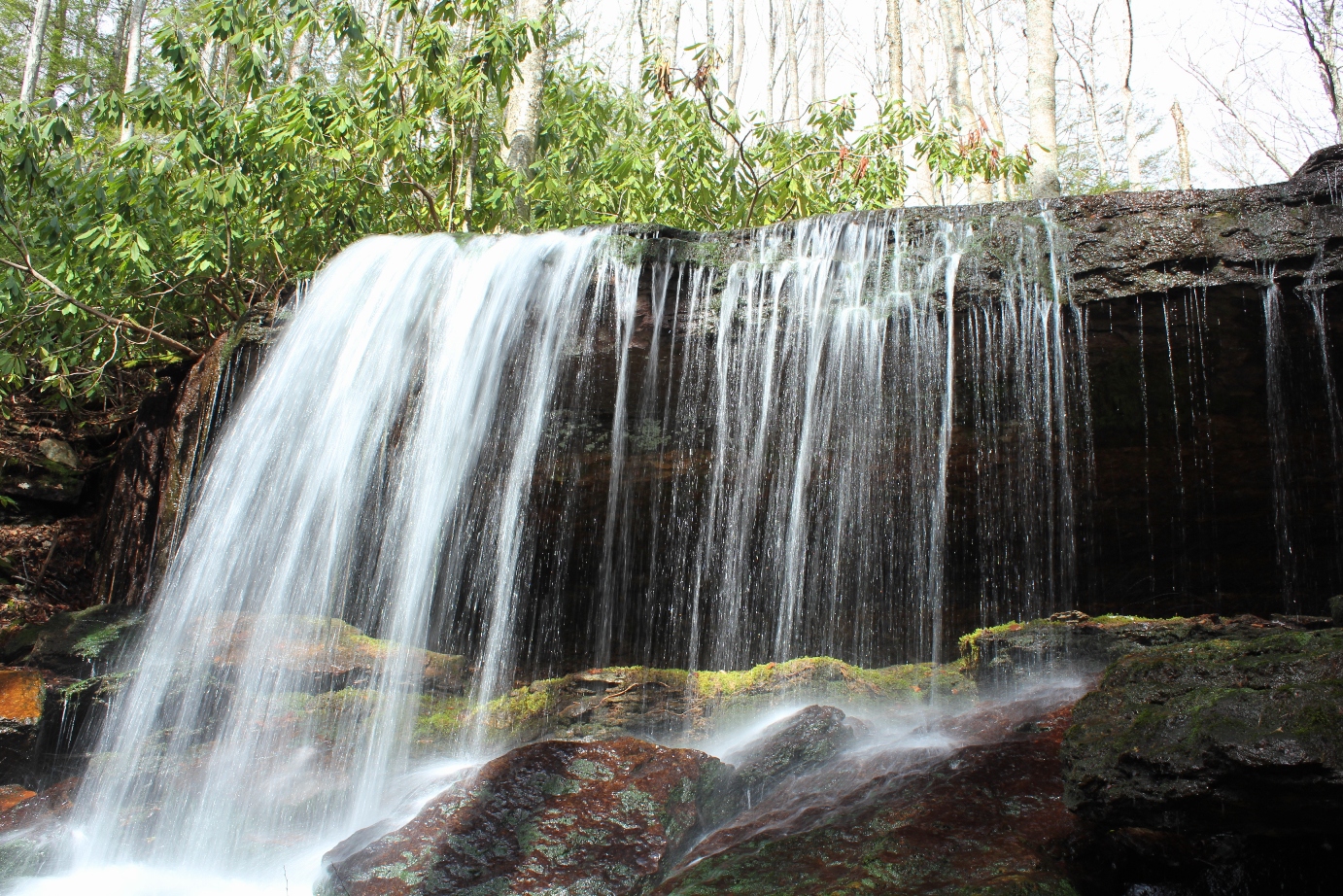
My son Karl made it all the way to the bottom and took some nice shots of the lower end of the falls, including this photo:
Lower Rowland Creek Falls Photo by Karl Thiessen
Below is a map of the entire scenic area. Rowland Creek Trail and Jerrys Creek Trail can be connected by either FR 84, or an older, no longer used forest road that parallels FR 84 about 100′ downslope of it. This loop is about 12 miles in length. It is also used by mountain bikers, although there are sections that are very difficult due to the grade and the wetness near the creek beds.
Check out these photographs of falcons and falconry from a new Northern Virginian blog on photography. Falconry, the ancient sport of taking quarry with raptors, is not widely practiced in the United States, although there is a Virginia Falconers Association.
A Falcon's View in Tennessee
If you investigate a little bit you will learn there is normally an “apprenticeship” whereby an aspiring falconer will work with a more senior bird handler to learn how to trap, manage and train a falcon. The apprenticeship may take years. Falconers must obtain U.S. Fish and Wildlife Permits in order to trap and keep these birds.
Having a falcon return to you and land on your arm would be exhilarating—presuming, of course, that you were wearing a protective gauntlet (otherwise your exhilaration would be tempered by extreme pain as the raptor’s talons clamped down on your forearm).
These photos reminded me of a backpacking trip a friend and I took several years ago wherein we accidentally came upon several wild raptors that flew extremely close to us. It was a bit unnerving to have birds of prey buzz so closely by. A few minutes later we would realize why the birds were flying so close to us.
We were hiking the Appalachian Trail in the Bald Mountains, up on the North Carolina-Tennessee border about 10 miles north of Sams Gap. As we rounded some large boulders, we accidentally came upon the Big Bald Banding Station. There were some individuals near the summit of Big Bald Mountain collecting data, and there were birds of prey that were either nesting or returning to the area. There were also some large bird cages, and, if I recall correctly, we observed several birds being released.
The sheer randomness of our coming upon these guys and watching the magnificent birds was pretty neat. In fact, we were so surprised that neither of us remembered to take our cameras and photograph the birds. We probably could have gotten some shots like those in the article highlighted above. The birds we saw were not trained, but were wild and free and were probably just passing through, stopping briefly on their way south for the winter.
On Top of the World - Eastern Falcon Migration Throughway
Big Bald Mountain, at 5516′, is one the higher points on the AT (and the highest between the Roan balds to the north and the Smokies to the south). The hike on the AT from Spivey Gap (Route 19W, aka Spivey Mountain Road) to Big Bald Mountain is a steep, rugged hike. The Bald Mountains are a natural bird migration throughway, and both large birds and smaller species cross the mountain during the seasons.
Southern Exposure: View of the Smokies from Big Bald Mountain
Immediately above the confluence of Little Brumley Creek and Brumley Creek on Clinch Mountain is a unique 16-20 foot plunge-type waterfall known as Little Brumley Creek Falls.
Little Brumley Creek Falls
This past weekend some friends, my son, and I hiked, climbed across mountainsides, and otherwise bushwhacked through state forest to reach this remote waterfall.
This waterfall is unique in that the waterfall drops over a huge slab of overhanging rock. There is a shallow cave behind the falls. You can actually get up in the cave and walk behind the falls.
Little Brumley Creek Falls Front View
Here is some footage of my son and another person in our party walking behind the falls:
2011-2012 has been a mild winter. Last night we finally received a decent snowfall. The Weather Channel was just up the road in Wytheville reporting live while I-81 got hammered. To the west in the coalfields we also got a pretty good snow, and all the schools in the region were closed today.
Early Morning Twilight
The trend this season has also been that on the occasions we have received any accumulation, it’s been gone within 24 hours. This morning I did get a few quick shots of the snow clinging to the dogwoods with the mountains in the background. As soon as the sun rose, the snow began to melt.
Glistening Sunrise
As usual, the white winter blanket of beauty was fleeting. By this evening the snow was all gone.
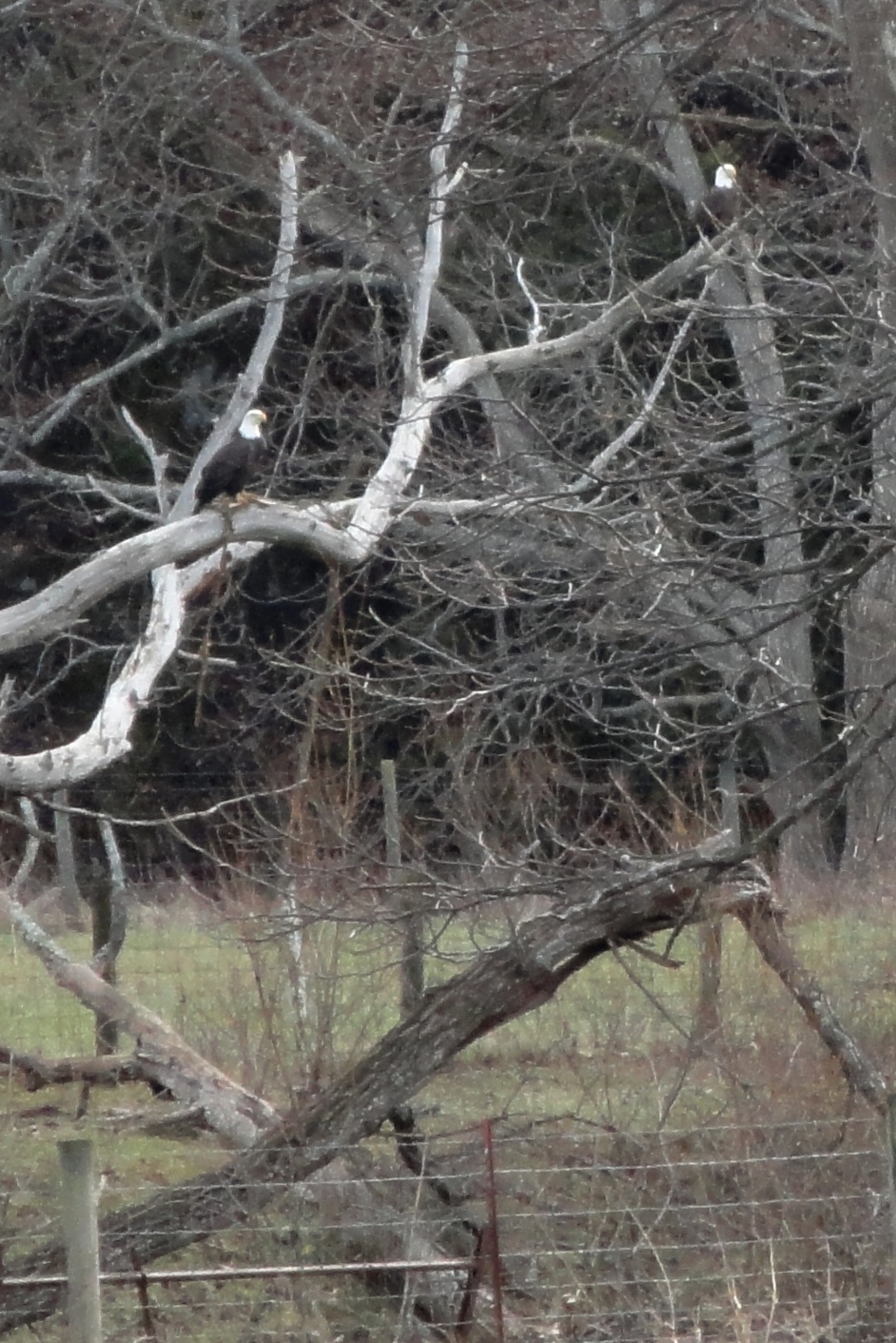
There have been more bald eagle sightings in Southwest Virginia this fall and winter. The sightings are becoming more widespread. I have heard first-hand accounts of bald eagle spottings at Hidden Valley Lake and at Clinch Mountain Wildlife Management Area, as well as on private land in Washington County between Abingdon and Damascus. Here is a photo my brother-in-law James Bear took of two eagles in December:
Bald Eagles in Wythe County, December 2011
The increase in bald eagle sitings was also recently profiled in a local article:
Sightings of bald eagles are still rare enough that people like Osborne and his neighbor are excited to spot one. However, Boynton, a bird watcher himself, says if individuals know where to look, it’s not difficult to see a bald eagle in Southwest Virginia or Smyth County.People regularly spot bald eagles, Boynton said, at Laurel Bed, Claytor and South Holston lakes as well as along the New River. In Smyth County, the wildlife biologist said, eagles can be seen along the Middle Fork and at DGIF’s trout hatchery on Rt. 16 and some private trout farms.
While the bald eagle’s presence has been growing in the region for some time, Boynton did note a new observation that now some nests are being located in Southwest Virginia.
Southwest Virginia, Upper East Tennessee, and Western North Carolina have lots of small creeks that are usually more fishable in winter. In winter the water levels may be higher than the summer or fall, there’s no foliage and less brush to block access to the water, and the creeks are no longer clogged with the fallen leaves. It’s a great time of year to hit these creeks, especially during breaks of mild weather.
Wild, Creek-Caught Brown Trout in Smyth County, Virginia, January 2012
You’re not likely to catch lunkers in these waters, but the trout are more likely to be wild and more beautiful than the stockers in the rivers and lakes. They may also be willing to hit dry flies even when there’s no hatch coming off the water. These small creek trout don’t have the luxury of waiting for a full-blown hatch. They’re often stuck within the confines of small pools; this requires them to be particularly opportunistic feeders; and insects on the surface are opportunities to them regardless of season.
There is something especially rewarding about the adventure of hiking where few fishermen have been, where the trout may not have seen men or their fishing gear for a long time before you, and where you have a genuine belief that you are exploring the natural world.
In the Eastern United States, there are not many places that instill these feelings anymore. It has been this way for almost a century:
Most of the truly secret streams were small. The larger streams had names, a public sort of character, commercial importance, perhaps. They were accessible: if they held trout it became known and they were visited regularly throughout the open season. Without restocking they became at last depleted of fish.
But the little back-country feeder brooks were nameless, and inaccessible save by long tramping over the ridges and upland meadows which lay deep beyond the infrequent roads. In such remote rills, known only to ourselves and our most intimate partners, the brook trout swam and lurked to meet his chilly destinies much as he had in the first days of the world. Some of these streams are still where they used to be. . . .
Howard T. Walden, II, Upstream & Down, at 171-72 (First Edition 1938).
In Upstream & Down, Mr. Walden explained that in the East, except for in the “remote semi-wilderness counties,” most small streams were under increasing pressure from development and anglers in the early Twentieth Century. He lamented “the loss of the virgin stream of olden time.”
These days, even in the “remote semi-wilderness counties” of the East (acknowledging that the definition of Eastern “remote semi-wilderness” is probably different today than in the 1930s), there are very few, if any, “nameless” small streams. Nonetheless, the essence of what Mr. Walden wrote back in the 1930s is still true: Remote small streams are still the most likely places to find unspoiled trout waters.
Wild Creek in the Jefferson National Forest, Smyth County, Virginia
In the reality of our increased population and the informational resources of modern times, there is not just a geographical dimension to being adventurous in the outdoors—whether fishing for trout, or otherwise (hiking, backpacking, etc.). There is also a seasonal dimension. Most fishermen hang up their rods and reels come late fall, and many do not take the sport up again until the traditional opening days of April. Thus the ardent angler is far more likely to have a solitary and adventurous experience in winter than in spring, summer, or fall. This is not to say that small creek fishing is not rewarding in the fairer seasons, just to point out the undeniable fact that it is more likely to hold an excitement that comes from undisturbed exploration in the wintertime.
Trouty Water in the Virginia High Country, December 2011
So I will continue to fly fish in wintertime, even if I catch less trout during this season. For while catching trout is the “point of the whole exercise” (as fellow small stream enthusiast and Trout Underground author Tom Chandler has stated), it is not the sole—or perhaps even driving—reason that we engage in this sport.
Exploring Quarrryish Water in Wintertime
P.S. — I will write more about Upstream & Down, a fascinating book, and Mr. Walden’s thoughts about trout fishing in subsequent articles.














 Abingdon Outdoors
